2021 ENG

The key legal aspects of the new royal decree-law 26/2021 on capital gains. What can happen?

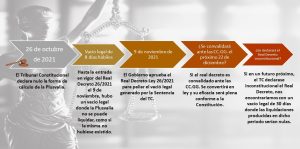
On 9 November, Royal Decree-Law 26/2021 of 8 November was published in the Official State Gazette, which fills the legal vacuum left by Constitutional Court Ruling 182/2021 on the calculation to determine the taxable base of the now colloquially known “Plusvalía”, which we have previously discussed in our blog (link here).

This legal route has been the most frequently used to fill the legal vacuum, but is it in accordance with the law?

Safeguarding the principle of legal reserve established in the Constitution and the General Tax Law, the Royal Decree-Law is a regulation with the status of law, and therefore has sufficient legal and legislative force to be used in this way.

However, Article 86.1 of the Spanish Constitution regulates these legal instruments for “cases of urgent and extraordinary necessity”, but “which may not affect […] the rights and freedoms of citizens regulated in Title I”.  Where is the article that lays the foundations of tax law regulated? In Title I (Article 31 EC).

Although it might seem unconstitutional because of what we have mentioned, there is Constitutional Court case law which states that tax matters can be regulated by means of royal decrees-Law, but without affecting or regulating essential elements of taxation, since, in this case, it would have to be done by means of a law (issued by the Cortes Generales).

Following the Constitutional Court’s jurisprudence, this is where Royal Decree-Law 26/2021 would falter, given that what it regulates is the way in which the taxable event of the Tax on the Increase in Value of Urban Land is calculated, this being an essential element of all taxation.

On the other hand, the same article 86 of the EC establishes a period of 30 days for validation of the Royal Decree before the Spanish Parliament.

If this Royal Decree were validated before the Cortes, it would already have a valid normative character and its constitutionality would not be questionable.

However, the 30 days that this regulation has been passed by Royal Decree could lead to its unconstitutionality (always declared by the Constitutional Court) and, consequently, its nullity, thus generating a new legal vacuum.

At MDG Advisors we are waiting to find out if the Royal Decree will be validated and to find out all the effects on tax matters that this situation may entail and the possible unconstitutionality of the same, as well as trying to answer the questions that this whole situation raises. If you have any doubts in this regard, please do not hesitate to contact us to be attended by our tax advisors.

Gibraltarian companies may be subject to taxation in Spain.

On 13 March 2021 and with effect from 2022, an International Agreement on taxation and double taxation between Spain and the United Kingdom in relation to Gibraltar has recently been approved. The Agreement creates a set of rules to define tax residency, prevent double taxation and introduce transparency between Spain and Gibraltar on tax matters. Due to our geographical location in relation to Gibraltar and the scope that this Agreement may have in taxation and fiscal matters, we will analyse the most important aspects.

This Agreement represents an important step forward in international relations between the two countries, as it represents an unprecedented agreement on tax matters, where both parties strengthen their international relations in the pursuit of common interests.

The Agreement establishes a series of casuistry and requirements where the tax residence will be Spanish, which we highlight:

For example, in the case of an organisation based in Gibraltar whose assets (real estate, among others) are largely located in Spain, it will have Spanish tax residence.

This Agreement represents a turning point in the taxation of organisations that tried to benefit from the 10% or 20% Gibraltar tax rate despite carrying out the bulk of their operations in Spain or having real estate in Spain, since, with this Agreement, the formal aspects of the incorporation or management of the organisation are set aside in favour of having tax residence where the bulk of the organisation’s business or management is physically located and, consequently, its taxation.

There are also tax developments for individuals regarding the transfer of their tax residence between the two countries.

At MDG Advisors we will propose the best solutions to our clients who are involved in this situation. If you have any queries, please do not hesitate to contact us.

The constitutional court declares unconstitutional and null the method of calculating the taxable base of plusvalía”

As we announced in our blog last week, the Constitutional Court has published its sentence on the unconstitutionality issue 4433/2020 regarding the Tax on the Increase in Value of Urban Land or, colloquially known as “Plusvalía”.


CONTEXT OF THE TAX CONTROVERSY


In order to understand the context of the controversy surrounding this tax, we should point out that this sentence is not the first to rule on the constitutionality of this tax. There have already been various constitutional notices and, specifically, the STC 26/2017 covered the issue of its tax object.


This sentence already established that “we are not, therefore, faced with a tax that subjects a transfer of assets to taxation, as the object of the tax is not linked to the fact of the transfer, although this is used to trigger the tax obligation; nor are we faced with a tax that taxes assets, as its object is not the mere ownership of the land, but the increase in value”, so the lack of legal basis of this tax had already been anticipated.


On the other hand, STC 59/2017, in its Legal Basis 13, established that, with respect to the challenged articles, “the fiction that an increase in value liable to taxation has taken place at the time of any transfer of land simply because the owner has kept it in his estate for a given period of time”. This means that tax would be levied on non-existent wealth and contravenes article 31 of the Spanish Constitution because the tax is not made taking into account the public or private urban development action and, therefore, an increase in value.

In conclusion, in 2017 the Constitutional Court declared two articles unconstitutional on the grounds that they were subject to taxation in situations where there was no increase in value and in 2019, the Constitutional Court declared “Plusvalía” unconstitutional when it was higher than the increase in value.


WHAT DOES THE CONSTITUTIONAL COURT ESTABLISH IN ITS LATEST SENTENCE?


In the current sentence under analysis, the Court applies the constitutional doctrine of past sentences regarding the configuration of this tax and declares articles 107.1, second paragraph, 107.2.a) and 107.4 of the TRLHL (Spanish legislation) null and void regarding the determination of the tax base “for unjustifiably contravening the principle of economic capacity as a criterion for taxation (art. 31.1 CE)”.


Furthermore, it establishes that “the maintenance of the current objective and compulsory system for determining the tax base, as it is alien to the reality of the real estate market and the economic crisis and, therefore, outside the economic capacity levied by the tax and demonstrated by the taxpayer, violates the principle of economic capacity as a criterion for taxation (art. 31.1 EC)”.


However, the reality is quite different, since the application of the principle of economic capacity as a criterion or parameter of taxation to the rule for quantifying the taxable base of “Plusvalía” has led the High Court to consider articles 107.2.A and 107.4 of the TRLHL (Spanish legislation) unconstitutional for “establishing a single method for determining the entire taxable base, and not part of it, of an objective nature and of mandatory application”.


The legislator intended to create an objective valuation rule for the increase in the value of the land and that, on the contrary, economic reality has questioned this presumption, as the tax base of the tax is far from the idea of quantifying increases in value. For this reason, the Constitutional Court established that the tax cannot be based on situations unrelated to the economic capacity of the taxpayer, as this could contravene the principle of non-confiscation.


Also noteworthy is the Court’s reference to the fact that “the legislator enjoys a wide margin of freedom in the configuration of taxes”, although the principle of economic capacity “as a measure of the tax burden” is a limit to the legislator’s configuration.


WHAT ARE THE EFFECTS OF THIS SENTENCE? CAN IT BE CLAIMED?


As we already knew through the informative note of 26 October 2021, the sentence establishes important limits to its scope and effects in order to guarantee legal certainty.


Firstly, the declaration of unconstitutionality of the precepts analysed means that they will be expelled from the legal system, which means that Local Public Bodies will be aggrieved as, from 26 October 2021 (the date of publication of the sentence), they will not be able to make settlements for this tax and a legal vacuum that should be resolved for greater legal certainty.


Likewise, something to be highlighted is that “it is the legislator (and not this Court) who, in the exercise of its freedom of regulatory configuration, will carry out the relevant modifications or adaptations to the legal regime of the tax to adapt it to the requirements of art. 31.1 EC, as highlighted in all the constitutional pronouncements on the legal precepts now annulled”, so we must await to know whether a new tax quantification will be configured for this tax or whether, on the contrary, the legal vacuum of this tax will remain.


Secondly, with regard to your possible claim, the Court is quite clear and closes the door to any type of claim with retroactive effect for those levies of this tax that have been “definitively resolved by means of a judgment with the force of res judicata or by means of a final administrative resolution” as of the date of publication of the judgment (26/10/2021), in addition to:


  • Provisional or final settlements that have not been challenged at the date of this sentence.
  • Self-assessments whose rectification has not been requested under article 120.3LGT at that date.


These limitations and effects eliminate any type of positive result for those judicial and/or administrative proceedings that have not been initiated prior to the sentence.


Finally, at MDG Advisors we will be waiting to find out what measures the legislator will take with regard to the new configuration, if it will be implemented and what the long-term effects of this court sentence will be.


Law 5/2021, of 20 october, on assigned taxes of the autonomous community of andalusia.

Last 26th October 2021, the new Law 5/2021, of 20th October, on the Devolved Taxes of the Autonomous community of Andalusia, was published in the BOJA (Official Gazette of the Autonomous Community of Andalusia).

This new regulation, according to its Second Final Provision, will come into force on 1st January 2022, except for the following precepts which came into force on 27th October 2021, repealing Decree Law 7/2021 of 27 April and various precepts of Legislative Decree 1/2018:

Transfer Tax (ITP)

– General fixed tax rate applicable to real estate (Article 41 of Law 5/2021) of 7%, repealing the rate according to the tables in Article 34 of Decree-Law 1/2018.

– Reduced tax rate to promote a social housing policy (art. 43 Law 5/2021). This new regulation includes new specific rates of 3.5% for habitual dwellings whose value does not exceed €150,000 and provided that the acquirer is a victim of domestic violence, a victim of terrorism or an affected person and for those municipalities with depopulation problems.

Stamp Duty (AJD)

– General tax rate for notarial deeds (Art. 49 Law 5/2021) of 1.2%, unchanged with respect to the repealed Decree Law 7/2021.

– Reduced tax rate to promote social housing policy (Art. 50 Law 5/2021). As in the case of onerous property transfers, new specific rates of 0.3% are included for habitual dwellings whose value does not exceed €150,000 and provided that the purchaser is a victim of domestic violence, a victim of terrorism or an affected person and for those municipalities with depopulation problems.

At MDG Advisors we are constantly evolving so that our tax compliance service is in constant search for excellence. For this reason, our team is analysing the recent Law 5/2021, of 20th October, to find out about all the tax innovations that will come into force in 2022, and we will inform about it in the next few days.

The constitutional court declares the municipal capital gains tax (“plusvalía”) unconstitutional.

The High Court has declared unconstitutional and null and voided a large part of article 107 of the TRLRHL, which was the fundamental pillar for the calculation of the taxable base of the municipal capital gains tax on the increase of urban land (“Plusvalía”).

The unconstitutionality has occurred due to the fact that the calculation of this tax is not in line with reality, understanding that the method of “determination of the tax base of this tax determines that there must be an increase in the value of the land during the period of taxation, regardless of whether there has been this increase and the actual amount of that increase”, so it puts at risk the principle of economic capacity regulated in Article 31 of the Spanish Constitution.

At MDG Advisors we are waiting for the Constitutional Court to publish the judgement in full in the next few days in order to carry out an exhaustive study of all the fiscal and tax repercussions that could arise for taxpayers and advice our clients accordingly.

Tax opportunities for non-eu non-residents with the modification of the law 11/2021.

The entry into force of the Law on Measures against Tax Fraud (Law 11/2021 of 9 July) has meant a turning point in the taxation of non-EU non-resident taxpayers in relation to their assets located in Spain.

With the entry into force of this law, the taxation of non-EU non-residents is equal to the taxation of EU non-resident taxpayers, being able to pay Wealth Tax according to the autonomic legislation where the assets of greater value are situated, and there may be interesting tax benefits in comparison with national legislation (Disposición Adicional 4ª de la Ley 19/1991).

For further information, please do not hesitate to contact our team at info@mdgasesores.com.

Leticia Cayuela and Jesús Raya

Tax Compliance Department

MDG news on taxation

We are writing this post on the occasion of the publication of the new Law 11/2021, of 9 July, on measures to prevent and combat tax fraud. This law introduces regulatory changes that affect taxation, which we highlight below:

  1. The system of surcharges for late filing without prior notice is modified: according to (article 27.2 LGT): An additional 1% + 1% is established for each full month that the self-assessment or declaration is submitted late for the first 12 months, in the case of more than 12 months, 15% + interest is established.
  1. Tax statute of limitations: For all tax returns for which the statute of limitations expires after 01/07/2021, the 78 days of suspension of the tax periods due to the pandemic are no longer counted.
  2. Modification in the reduction of penalties:
  • Conforming Minutes:

o   If the settlement is not appealed: The penalty is reduced by 30%.

o   If the settlement & penalty is not appealed and is paid in the voluntary period: the penalty is reduced by 40% on the amount already reduced by conformity.

o   If the penalty is appealed: the penalty is reduced by 30% but the 25% reduction will not apply.

  • Minutes with agreement: reduced by 65%.
  1. 4. Obligation to report on virtual currencies located abroad in model 720.
  2. Taxes on Inheritance and Donations/ Wealth tax / Transfer tax: the taxable base will be calculated on the basis of the market value. In the case of real estate, the market value will be the reference value indicated by the Cadastro Inmobiliario on the date of accrual.
  3. Tax on Economic Activities:
  • Both resident and non-resident individuals are exempt from tax.
  • When the entity forms part of a group of companies, the INCN (Net Turnover) will refer to all the entities belonging to that group, irrespective of the accounting consolidation obligation.
  1. The maximum amount that can be paid in cash is reduced to € 1.000however when the payer is an individual who can prove that he/she is not resident in Spain, the amount paid in cash may be € 10.000.

Should you have any questions, we remain at your entire disposal.

MDG Advisors Team,

Decree-Law 7/2021 of 27th April – Reduction in the rate of Transfer Tax and Stamp Duty Tax (“ITP / AJD”)

We would like to inform you that yesterday, 27th April, Decree-Law 7/2021 of 27th April was published in the Extraordinary  BOJA number 37, reducing the rate of Transfer Tax and Stamp Duty Tax (also known as “ITP/AJD” in Spanish) to boost and reactivate the economy of Andalucía in the face of the crisis situation caused by the coronavirus pandemic (COVID19).

With exclusive validity for taxable events accrued from the entry into force of the Decree-Law (today, 28th April) until 31th December 2021, the current scale of the Transfer Tax is replaced by a single rate of 7%.

Likewise, with exclusive validity for taxable events accrued from the entry into force of the Decree-Law (today, 28th April) until 31th December 2021, the rate applicable to the Stamp Duty Tax becomes 1.20%.

Post-BREXIT ERA: new taxation at 24% for British entities that have real estate in Spain for the use of their partners or administrators.

It is undeniable that BREXIT is deeply changing trade relations between EU countries and the UK, and in tax matters this change is not far behind.


Today we would like to report on a specific case of change in taxation in Spain that may affect certain structures of British companies and partners with real estate property located in Spain.


For some years now, the Spanish Tax Agency has maintained the criteria of imputing real estate income at market value to non-resident companies with a property in Spain, when the non-resident shareholders and/or administrators use the property for private purposes. In other words, due to the mere availability of the property, the non-resident entity will have to pay taxes on this imputed income.


In order to justify this taxation, the Directorate General for Taxation, on its the binding consultations, first refers to the Double Taxation Agreements to determine whether this income can be taxed by the Spanish government. Thus, in the case of the Double Taxation Agreement between Spain and the UK, we see in Article 6 that the Spanish State may tax income derived from the direct use of immovable property located in Spain, when the ownership of shares directly or indirectly entitles the owner of such shares the right to enjoy the immovable property.


Consequently, income derived from the use of the property may be subject to taxation in Spain, as is also regulated internally in Article 13.1.g) of the Non-Resident Income Tax Law, where the following, among others, are considered income obtained in Spanish territory: “g) Income derived, directly or indirectly, from real estate located in Spanish territory”.

With regards to the valuation of this income, since shareholders and/or directors are related parties with respect to the non-resident company, all transactions carried out between these related entities will be valued at their market value. Market value shall be understood as the value that would have been agreed by independent parties under conditions that respect the arm’s length principle.

Therefore, in accordance with the above, the non-resident company will obtain taxable presumptive income in Spain from the use of the property by the shareholders and/or directors.

This taxation, until 2020, was 19% for British entities as an EU member state with full deduction of expenses related to the property. After BREXIT, the United Kingdom no longer belongs to the European Union, and therefore, with effect from 01st January 2021, the taxation rate will be 24% on this presumed income due to the fact of having the property located in Spain, with NO deduction of expenses.

Therefore, British entities, after the BREXIT, have been seriously harmed in terms of taxation in this case by seeing their taxation increased by 5 percentage points, and the impossibility to deduct any expense. At MDG Advisors, we offer our services to check and analyse the new situation of British entities that are affected by this fact. Please contact us if you are in this situation so that we can assist you as soon as possible.