
2021 ENG

Soft Landing
Relocating to Spain and getting lost with all the paperwork to be made? Let your hair down, we will assist you with all the necessary changes, so you can enjoy the weather and sunshine 🙂
Our helpful soft-landing service will make you to resolve the following (and numerous) issues:
a) Obtaining Social Security number
This step is the very first thing that we will help you with. IN order to sign your employment contract with your company, you will need to have the Social Security number.
Such number will provide you coverage in the Public National Health system in Spain.
b) Applying for residence (“Certificado de Registro”)
NIE is required in Spain for almost all paperwork. As soon as your employment contract is signed, we will be able to start the process.
c) Changing your tax residency to Spain.
In Spain, any person staying in the country for 183 days or more in a calendar year, is considered as Spanish Tax Resident.
The fact of obtaining a “Certificado de Registro” does not imply to change the tax residency country and therefore, in order to avoid any future misunderstanding with the Spanish Tax Authorities, we will inform them upfront of your new tax situation.
d) Opening a bank account
Your new company will be likely to require and Spanish IBAN in order to make the monthly payslip payments.
Due to the language barrier, as well as lack of contacts, opening a bank account in Spain can turn into a complicated matter for an expat, and therefore, if needed, we can put you in touch with the right person to complete the process.
e) Registration in the local Town Hall (“padrón”)
Once you have found your property, we can help you with your registration in the Town Hall. This will help you to receive the post correctly, and will make you appear on the Town Hall records.
f) Tax obligations in Spain.
When becoming tax resident in Spain, you will have to deal with some of the following tax obligations:
Model 100: Personal Income Tax declaration to be submitted between April and June each year.
Model 151: Personal Income Tax declaration for individuals accepted under the Special Regime for expats (commonly known as “Beckham Law”)
Model 720: informative tax declarations for individuals with assets abroad for a total value of Euros 50,000 or above
We will be pleased to assist you also with your tax obligations in Spain.

Tax Compliance: Moving your business to Spain- To do List
Relocating your business offers many benefits, yet also comes with its share of business challenges: designing systems and processes, managing cash flow, securing the appropriate talent and training staff at large, etc. Another consideration exists that is just as critical – especially since it often presents unforeseen issues: Compliance.
Failing to remain legally compliant can unleash a huge of serious consequences for businesses, including reputational harm, administrative sanctions or company responsibility.
To prevent such consequences, it helps to have a list of the common steps that new companies in Spain may take into consideration:
- Setting up a Company
Once the decision of relocating into Spain is final, the main actions to take are:
- Asking for shareholders and director’s NIE number, or NIF instead (check this point in section 2), in case of being foreigners.
- Possibility of giving a power of attorney to your lawyer or tax advisor to speed this proceeding, mainly during these transitory times that travelling is not easy.
- Asking for the possible company name before the Central Mercantile Register. 5 possible names are needed for this proceeding.
- Prepare the complete data of the shareholders and directors of the company. Also, the share capital (deposit in a bank account, cash, any asset…) and the mainly social activity, so the Notary can make the draft of the title deed quickly and efficiently, ready to sign in the moment the client wishes.
- The Notary or tax advisor itself, will ask for the provisional Fiscal Identification of the company before the Tax Agency.
- Bringing the title deed to the Mercantile Register to its registration.
- Consider this operation may take between 2-3 weeks to be completed, bearing in mind possible difficulties (Notary’s appointment, delays in the registration before the Mercantile Register).
- And finally, bearing in mind the costs involve Notary and Mercantile Fees, along with your tax or legal advisors’ fees, to mention the principle ones.
- Obtaining a NIF for tax matters, no need of NIE
For some Tax purposes, there is no need to obtain a NIE number, it is enough the ID number that the Tax Agency provides only for these situations.
Donations, Inheritances, property transactions… all these taxable operations can be easily fulfilled by your legal or tax advisor with no need of a power of attorney.
Therefore, this NIF (Fiscal Identification Number) will give the client the possibility of not moving into Spain. There is no need of being physically here neither granting a power of attorney, with an authorization would be enough. Your advisors will take care of this proceeding on your behalf.
Quite important could be this NIF for companies to be established in Spain, whose holding is a foreign company. This foreign company will also need this kind of Identification number to complete the setting up of the Spanish company, so the Tax Agency has a registration of the holding.
- Compliance for starting companies
Starting a new company in Spain can involve many administrative proceedings. For tax matters and to be compliant, you can find here the first steps the new company will have to take care of:
- Submit Model 036 (Census declaration) of registration before the Tax Agency and the main tax obligations of the company, and ask for the definite ID of the company. Not being correctly registered can produce administrative sanctions.
- Important to ask for the registration of the company in ROI/ VIES (Census of intracommunity operators) to be able to issue and receive invoices with no VAT in the corresponding situations. This is a formal condition, but needed before the Tax Office to avoid any unpleasant inspections.
- Request your tax advisors for the information about the monthly/ quarterly tax obligations your company may have (VAT declarations, retention on payslips declarations…). It is important to give all the useful information to your advisors, so they will be able to complete your tax obligations efficiently and again, avoiding possible sanctions and tax inspections.
- Also, ask for the social security costs of your employees monthly paid. This is an important cost, together with salaries, that every company needs to control carefully. There can be sanctions by the Social Security Office if the labour matters are not correctly fulfilled.
- Collect and save in a secure file all the invoices and documents produced every month, to have a finance and accountancy control of all inputs / outputs.
- Finally, bearing in mind every Spanish company has 3 main mercantile annual obligations: prepare and submit Corporate Tax, prepare and submit Accounting Books and Annual Accounts. Even if a company is dormant, it will have these 3 obligations that will not be able to avoid, until the company is liquidated.
All these steps may prevent surcharges and sanctions before the Tax Agency, so we always recommend to have well informed your tax advisors and ask your questions with every change it may happen.

Spanish in-country compliance
Spain is commonly known as a country full of bureaucracy. Regardless the current COVID-19 crisis has led to a structural change, the reality is that public administrations in Spain still require loads of paperwork, especially in the business activities.
Companies and freelancers have to comply with numerous obligations, not only on the tax side, but also on the accounting, legal and corporate ones.
We summarize below main obligations (but not the only) that all companies need to look at when running business in Spain.
- Registration
- Tax payer census: if you are an individual you will have to register within the Tax Office records by submitting Model 030.
- Obtaining NIF: all companies operating in Spain need to submit an application (Model 036) and request a NIF from the Spanish Tax Authorities. BY doing that, the Spanish Inland Revenue ensures that all entities are within their files.
- Social Security: no matter if you operate through a company with personnel or as a freelance, you will have to inform upfront the Spanish Social Security.
- Electronic notifications: all companies in Spain must register on the electronic notifications system. In order to do so, it is required to obtain a digital certificate beforehand.
- Tax
- Model 036 or 037: before starting any economic activities in Spain, any company or freelance need to inform the Tax Office of what activities will be developed and the tax obligations that will apply by submitting an informative tax declaration called Model 036 ( Model 037 can be submitted by freelancers).
- VAT declarations (Model 303): depending on the type of activity, you may be required to submit VAT forms on month, quarter and/or annual basis. There are various VAT declarations (Model 303, Model 349, Model 390)
- Withholding tax declarations (Model 111, Model 216,Model 115…): In Spain, withholding tax is to be applied in numerous occasions. The payment of the withholding tax should be done by submitting different types of declaration.
- Corporation Tax (Model 200): all companies in Spain need to submit an annual Corporation Tax declaration, in order to report their results and financial statements to the Tax Authorities.
- Personal Income Tax (Model 100/151): all individuals (including freelancers) need to submit once a year a Personal Income Tax declaration, reporting their economic and personal situation.
- Accounting
All companies must maintain their accounts according to the Spanish Accounting Plan, using a double entry system.
The accounts of a company should show the true image of its activity through its financial statements, which include Balance Sheet, Profit and Loss Account and Cash-flow Statement, amongst others.
Any company must legalize Annual Accounts once a year at the Trade Register.
The information legalized at the Trade Register has public access and therefore, anyone can obtain a copy of the Annual Accounts of any company operating in Spain.
- Other legal obligations
- Data Protection Law: This legislation is mandatory for all companies/freelancers that collect and store data from individuals. The aim is to guarantee and protect, with regard to processing of personal data, public freedoms and fundamental rights of individuals.
- Risk Prevention Law: Companies and freelancers who have employees in charge need to design a prevention plan that carry out the necessary actions to avoid accidents in the workplace.
- Business Opening License: required procedure with the Town Hall, to ensure that the activity complies with the requirements and conditions established by the regulations.

Spanish in-country compliance
Spain is commonly known as a country full of bureaucracy. Regardless the current COVID-19 crisis has led to a structural change, the reality is that public administrations in Spain still require loads of paperwork, especially in the business activities.
Companies and freelancers have to comply with numerous obligations, not only on the tax side, but also on the accounting, legal and corporate ones.
We summarize below main obligations (but not the only) that all companies need to look at when running business in Spain.
- Registration
- Tax payer census: if you are an individual you will have to register within the Tax Office records by submitting Model 030.
- Obtaining NIF: all companies operating in Spain need to submit an application (Model 036) and request a NIF from the Spanish Tax Authorities. BY doing that, the Spanish Inland Revenue ensures that all entities are within their files.
- Social Security: no matter if you operate through a company with personnel or as a freelance, you will have to inform upfront the Spanish Social Security.
- Electronic notifications: all companies in Spain must register on the electronic notifications system. In order to do so, it is required to obtain a digital certificate beforehand.
- Tax
- Model 036 or 037: before starting any economic activities in Spain, any company or freelance need to inform the Tax Office of what activities will be developed and the tax obligations that will apply by submitting an informative tax declaration called Model 036 ( Model 037 can be submitted by freelancers).
- VAT declarations (Model 303): depending on the type of activity, you may be required to submit VAT forms on month, quarter and/or annual basis. There are various VAT declarations (Model 303, Model 349, Model 390)
- Withholding tax declarations (Model 111, Model 216,Model 115…): In Spain, withholding tax is to be applied in numerous occasions. The payment of the withholding tax should be done by submitting different types of declaration.
- Corporation Tax (Model 200): all companies in Spain need to submit an annual Corporation Tax declaration, in order to report their results and financial statements to the Tax Authorities.
- Personal Income Tax (Model 100/151): all individuals (including freelancers) need to submit once a year a Personal Income Tax declaration, reporting their economic and personal situation.
- Accounting
All companies must maintain their accounts according to the Spanish Accounting Plan, using a double entry system.
The accounts of a company should show the true image of its activity through its financial statements, which include Balance Sheet, Profit and Loss Account and Cash-flow Statement, amongst others.
Any company must legalize Annual Accounts once a year at the Trade Register.
The information legalized at the Trade Register has public access and therefore, anyone can obtain a copy of the Annual Accounts of any company operating in Spain.
- Other legal obligations
- Data Protection Law: This legislation is mandatory for all companies/freelancers that collect and store data from individuals. The aim is to guarantee and protect, with regard to processing of personal data, public freedoms and fundamental rights of individuals.
- Risk Prevention Law: Companies and freelancers who have employees in charge need to design a prevention plan that carry out the necessary actions to avoid accidents in the workplace.
- Business Opening License: required procedure with the Town Hall, to ensure that the activity complies with the requirements and conditions established by the regulations.

MDG Informs / Closure of Non-essential Activity in Málaga
As we have exceeded the figure of 1,000 COVID-19 infections in Malaga city, we have moved to alert level 4 grade 2. From today, Wednesday 3 February 2020, in the municipality of Malaga city, the opening to the public of all retail establishments that are not considered as essential activity is suspended. The duration will be 14 days.
Attached to this email: Resolution of 1 February 2021, of the Territorial Delegation of Health and Families in Malaga, as well as the Order of 8 November 2020, modulating alert levels 3 and 4 by COVID-19 in Andalucia.
Exceptions to the closure of the opening to the public are and, therefore, they can open with a time limit of 18.00 hours:
– Social and socio-health services
– Parapharmacies
– Food markets
– Hygiene products
– Press, bookshops and stationery shops
– Flower, plant and seed shops
– Mechanical workshops
– Repair services and building materials
– Hardware and household appliances
– ITV stations
– Tobacco shops
– Technological equipment and telecommunications
– Animal feed
– Dry cleaners and laundries
– Hairdressers
– Household employees
– Markets
They can be open without time restrictions:
– Commercial establishments selling food, beverages, products and basic necessities.
– Health centres, services and establishments
– Veterinary centres or clinics
– Professional and financial services, insurance
– Fuel services
– Home delivery services
In addition, all catering activities, both indoors and on terraces, are suspended. The following are exempt from this suspension:
1. Home delivery services. Likewise, food delivery services of a social or charitable nature.
2. Restaurants in tourist accommodation establishments, which may remain open as long as they are for the exclusive use of their customers.
3. Catering services integrated into health, social and social care centres and services, school canteens and canteen services of a social nature.
4. Other catering services in training centres not included in the previous paragraph, and catering services in work centres for workers.
5. Catering services at fuel supply establishments or loading or unloading centres or prepared food outlets, with the aim of enabling professional driving activities, compliance with regulations on driving and rest times and other activities essential for carrying out goods or passenger transport operations.
However, these measures do not apply to municipalities such as Benalmádena, Fuengirola, Mijas, Torremolinos, Antequera, Rincón de la Victoria, Cártama and Nerja. Where businesses are allowed to open, maintaining the perimeter fence.
MDG Advisors Team,

Why compliance is essential in the current economic environment?
In the context of uncertainty caused by COVID-19, many companies are looking for new ways to operate, whether if it means internationalization to find new markets abroad or a complete review of the structure to adapt to the remote work. This implies a loss of control in the management of the company. The best way to prevent from poor performances is by implementing compliance.
During the pandemic, those companies with better compliance systems in force could adapt easily to the constant changing environment. Moreover, coronavirus has only accelerated the technological disruption companies were facing during the last years. The speed of technology constantly alters the way that consumers, industries or businesses operates and only those with better internal compliance will be able to adapt.
We will list below the reasons why compliance is essential to face the current constant changing environment.
- Working in a New Normal business world
Although it is unclear how the post-pandemic business environment will look like, companies must be prepared to adapt to a new normal.
In addition to the critical factor of how the company manages the crisis to cushion its impact, it is equally important to have compliance plans in place to deal with it. One of the main challenges for companies will be to identify the new threats from which they will have to protect themselves.
Companies will have to focus on their core business in order to recover and having the correct compliance control will prevent them to expensive waste of time.
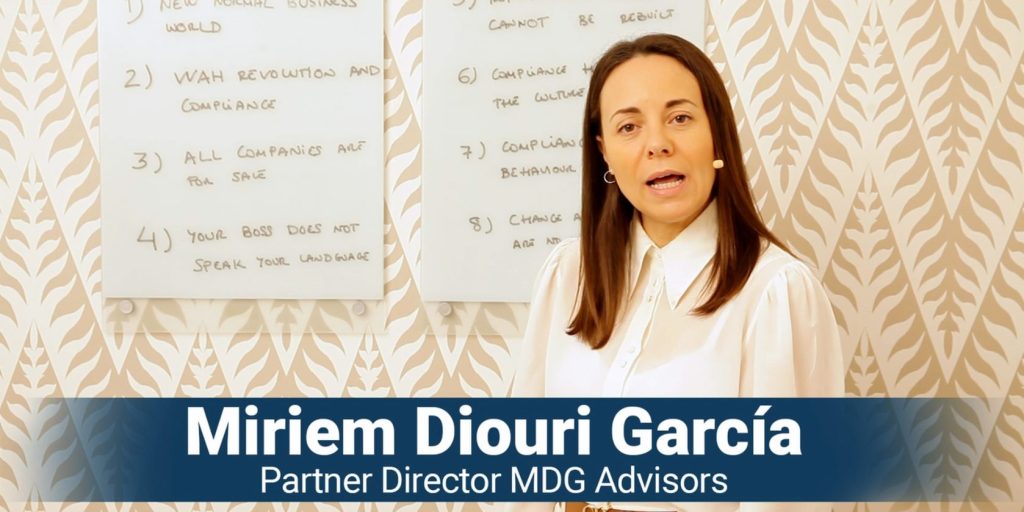
- WAH revolution and compliance
Working at home has become the biggest change of the century in terms of employment. Having all employees working remotely is now a reality both for big and small companies. Companies had to adopt telecommuting from one day to another, forced by the pandemic.
Having the proper technological remote systems was a key factor to this adaptation, after nearly 12 moths, it is now compliance the key to guarantee the quality standards are maintained.
It is not just the technological structure that conditions a proper adaptation to telecommuting. It is also essential the cohesion of the system provided by a good system of compliance.
Working from home is a litmus test for the compliance skills of any company.
- All companies are for sale
All companies are for sale is an idea frequently associated with the IT sector, but now this will be extended to many other sectors.
With a business world moving faster, pushed by technology and the constant change of offer and demand, all companies must be on the marked for sale and many of them will be sold to survive.
Not all companies, depending on their volume and flexibility, will be able to adapt to the new normal, selling could be a safe way out that will prevent many of them from bankruptcy.
A due diligence would be compulsory to sell any business. Having the right compliance advisor will save the company many hours and money to proof the diligence and good practice of the entity.
- Your boss do not speak your language
Globalization and internationalisation are two of the tendencies that will not be affected by the Pandemic and will not be stopped by the virus.
We may not be able to travel but business continue to expand to new countries looking for new opportunities and enforced by technology.
You may be end up having your manager in Hamburg, the accounting team in India and the HR offices in central London, and reporting to the shareholders in China. A common language is compulsory to operate in this scenario and compliance is the new Esperanto language for business.
- Reputational damage cannot be rebuilt.
People want to interact with organizations that have a reputation for honest dealings. It takes years to build a good reputation and this can be lost very fast, by the incorrect performance of any of your employees.
If you are not trusted in the marketplace, clients are unlikely to work with you. On the other hand, if you are trusted, clients will give you sufficient credit. Leaders consistently rank reputational risk as their number one worry.
- Compliance helps define the culture of a company
A compliance function leads an organization to determine a set of values and ethical principles that guide the organization’s behaviour. It requires the organization to describe those values and ethics sufficiently so that team members understand them and will refer to them.
Having a strong compliance control in the company determinates and shapes the company culture by showing the employees the importance of a correct behaviour.
- Compliance is a behaviour guideline
When compliance is properly done, it increases efficiency and effectiveness because employees have been trained to know, intuitively, how to do their jobs and how to reason through ambiguous situations.
- Change and innovation are no longer an option
Innovate or die.
Companies that adopt change and innovation to their performance will not take a better piece of the cake, but will just survive. Change and innovation are no longer an option.
In a constant changing entity, it is compulsory to have a proper system of compliance to guarantee you still take the reins of the company.
February, the month of Compliance at MDG
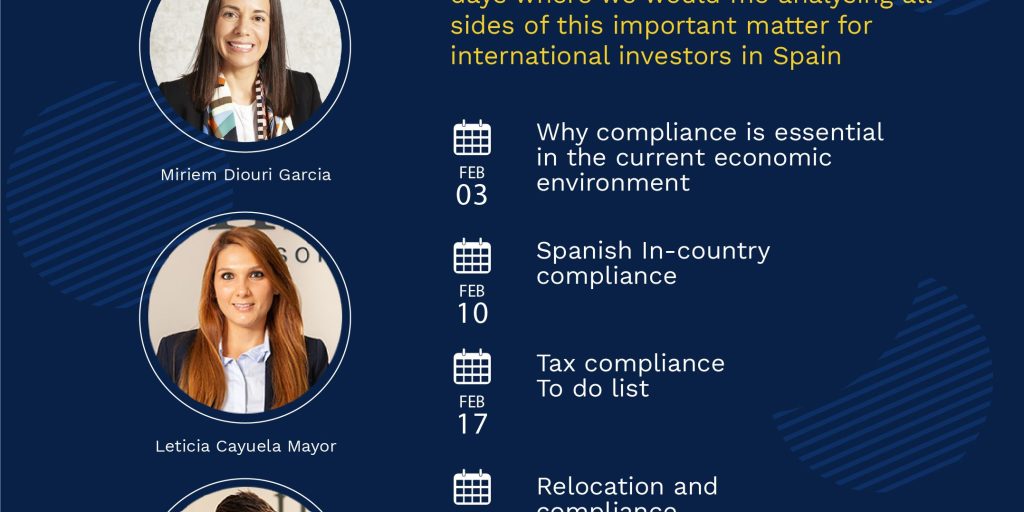
February, the month of Compliance at MDG
Come and join us on our Compliance days where we would me analysing all sides of this important matter for international investors in Spain.
– Why compliance is essential in the current economic environment ……3rd of February, 2021
– Spanish In-country compliance …..10th of February, 2021
– Tax compliance- To do list….17th of February, 2021
– Relocation and compliance….24th of February, 2021
#mdgadvisors#

MDG Informs / New measures for Andalucia BOJA January 16th 2021
With the approval of the Extraordinary BOJA number 6, last 16th January 2021, new measures have been implemented in Andalucia. All measures will be in force until 01 February 2021.
We attach this bulletin and certificate of travel between municipalities for work purposes.
Please, find below main details of these measures:
– Limitation of mobility at night: The curfew is maintained from 22:00 to 6:00 a.m.– Meetings in the private and public places: From 6 to 4 people.– Closing of Restaurants and Bars: It is brought forward to 18:00h. Home delivery is allowed until 23:30, with the limit of placing orders until 22:30 and collection in place until 21:30.– Peripheral closure of the 8 provinces and municipalities: Geographical mobility between provinces and outside Andalucia is prohibited without justified cause. In addition, forbidden entry and exit of municipalities that exceed 500 cases of accumulated incidence per 100.000 inhabitants.– Malaga municipalities affected by the restriction (as of today´s date): Almogía, Málaga, Macharaviaya, Moclinejo, Rincón de la Victoria, Totalán, Benahavís, Benalmádena, Casares, Estepona, Fuengirola, Istán, Manilva, Marbella, Mijas, Ojén, Torremolinos, Alhaurín de la Torre, Álora, Alozaina, Carratraca, Cártama, Casarabonela, Guaro, Pizarra, Tolox, Yunquera, Alhaurín el Grande, Ardales, Coín, Monda, Antequera, Archidona, Campillos, Cañete la Real, Cuevas Bajas, Cuevas de San Marcos, Fuente de Piedra, Humilladero, Mollina, Sierra de Yeguas, Valle de Abdalajís, Villanueva de Algaidas, Villanueva de la Concepción, Villanueva de Tapia, Villanueva del Rosario, Villanueva del Trabuco, Alameda, Almargen, Teba, Alcaucín, Alfarnate, Algarrobo, Almáchar, Árchez, Arenas, Benamargosa, Canillas de Aceituno, Canillas de Albaida, Casabermeja, Colmenar, Comares, Cómpeta, Cútar, Frigiliana, Iznate, La Viñuela, Nerja, Periana, Riogordo, Sayalonga, Sedella, Torrox, Vélez-Málaga, Alfarnatejo, Benamocarra, El Borge, Salares, Alpandeire, Arriate, Atajate, Benaladid, Benalauría, Benaoján, Benarrabá, Cortes de la Frontera, Cuevas del Becerro, El Burgo, Faraján, Gaucín, Genalguacil, Jimera de Líbar, Jubrique, Júzcar, Montecorto, Montejaque, Parauta, Pujerra, Ronda, Serrato, Algatocín, Cartajima, Igualeja. However, this list can be update everyday with new municipalities.
We remain at your disposal for any questions you may have.
MDG Advisors Team

Tax news 01/2021
We would like to inform that last December 31st the General State Budget Law 11/2020 was published, from which we extract the most relevant points:
*Personal Income Tax:
– The tax rate for incomes over Euros 300,000 is increased by two points. Except for modifications in the autonomous section, the marginal tax rate is 51.5% (until now 49.5%). Art. 58.
– A new section of 26% (state and autonomous section) is added for the base of savings exceeding Euros 200,000. Art. 59.
– The scale of deductions is updated in accordance with the new scale in article 58. (Article 60).
– Modification of the limits of reduction in the taxable base for contributions. Art. 62:
-All reductions made by all the persons who pay premiums in favour of the same taxpayer, including those of the taxpayer himself, may not exceed 2,000 euros per year (up to now 8,000 euros).-In the case of taxpayers whose spouse does not obtain net income from work or economic activities, this is less than 8.000 per annum, they may reduce the taxable base by the contributions made to social welfare systems in which the spouse is a participant, a member or a holder, with a maximum limit of 1,000 euros (so far 2,500 euros per annum).– As a joint maximum limit for reductions, the lower of the following amounts shall apply: 30% of the sum of the net income from work and economic activities received individually in the financial year and Euros 2,000 (so far Euros 8,000 euros per year).
*Limitation of the exemption on dividends and positive income derived from the transfer of securities representing the equity of entities resident and non-resident in Spanish territory. Art. 65:
1.- Limitation of financial expenses. To determine the operating profit for the purposes of quantifying the limit on financial expenses, only dividends from holdings in which the percentage of direct or indirect participation is at least 5% shall be added as financial income. In other words, financial income from shareholdings whose acquisition value is greater than EUR 20,000,000 but in which the percentage of ownership is less than 5% is no longer added to the operating profit.
2.- Exemption of dividends and income derived from the transfer of securities representing the equity of entities resident and non-resident in Spanish territory. Dividends and income derived from the transfer of securities are only exempt when the percentage of participation in the capital or in the equity of the entity is at least 5%. In other words, as with the limitation on financial expenses, it does not apply if the acquisition value of the holding is greater than 20,000,000 euros but the holding is less than 5%.
– However, a transitional regime has been established, so that holdings acquired in tax periods commencing prior to 1 January 2021, with an acquisition value of more than EUR 20,000,000 but less than 5% of the holding, may be exempted, provided that they meet the remaining requirements, for tax periods commencing within the years 2021, 2022, 2023, 2024 and 2025.– The non-deductibility of negative income arising from the transfer of a holding in an entity shall only apply when the percentage of ownership in the capital or equity of the entity is at least 5%, but not if the acquisition price of the holding exceeds EUR 20,000,000 and this percentage is not reached.– A transitional regime is also regulated, so that negative income arising from the transfer of holdings with an acquisition value of more than EUR 20,000,000, but less than 5%, acquired in the tax periods starting before 2021, cannot be included for tax periods starting within the years 2021, 2022, 2023, 2024 and 2025.
– The exemption for dividends and capital gains on the sale of shareholdings is limited to 95%. The rule creates a presumption that 5% corresponds to management expenses of the holdings.
– Exception to the above-mentioned reduction when, simultaneously, the following requirements are met:
-Dividends or shares in profits are received by an entity whose net turnover for the immediately preceding tax period is less than Euros 40,000,000 and which, in addition, is not patrimonial, does not form part of a mercantile group before 2021 and does not have a stake in another entity before that year equal to or greater than 5%.-Dividends or shares in profits come from an entity incorporated after 1 January 2021 in which it holds, directly and from the time of incorporation, all the capital or own funds.-Dividends or shares in profits are received in the tax periods ending in the three years immediately following the year in which the entity distributing them was incorporated.
3.- Deduction to avoid international economic double taxation. As with the exemption, dividends or shares in profits paid by a non-resident entity in Spanish territory are entitled to a deduction when the share in the capital of the non-resident entity is at least 5%. It will not be applied when the acquisition value of the holding exceeds Euros 20,000,000 and the percentage of holding is less than 5%.
As with the exemption, a transitional regime is established to continue applying the deduction, for dividends from holdings with an acquisition value of more than Euros 20,000,000 acquired in the tax periods starting before 2021, during the tax periods starting within the years 2021, 2022, 2023, 2024 and 2025.
This deduction, together with the deduction to avoid legal double taxation, may not exceed the full amount that would have been payable in Spain on this income if it had been obtained on Spanish territory. In order to calculate this tax, dividends or shares in profits will be reduced by 5% as management costs of the shares.
4.- Elimination of consolidation groups. The 5% of this income on participations and dividends as management expenses referring to these participations will not be subject to elimination.
5.- International tax transparency. The amount of dividends from holdings in a subsidiary with international tax transparency that is not included in the tax base (because the profits of the subsidiary were included) will be reduced by 5% as management expenses of the holdings. This reduction will not apply when the circumstances necessary to apply the exemption reduction for PYME with a net turnover of less than Euros 40,000,000 in the previous year are present.
*All percentages of the scale of wealth tax are increased by one point. However, since all the Autonomous Communities have set their own scale, this measure has no practical effect. Art 66.
*Soft drinks, juices and soft drinks with added sugars or sweeteners are now taxed at the general rate of 21%. Art. 69.
*A rate of tax on insurance premiums is set at 8% as opposed to the current rate of 6%. Art. 73.
Should you have any doubts, we remain at your disposal.