admin

Digital Nomad Visa – Recent amendments.

The order amending the Regulation on the Special Regime for Impatriates (Bechkam Law) will be approved soon, which means that the new groups that the Start up Law made possible, will be able to apply (spouses, self-employed with innovative activities and teleworkers). Important data:


– All these new groups will have a period to exercise the option of 6 months from the approval of the Order. There may be situations of spouses who moved in the second half of 2022, for whom a new range of options is now open, as they have not been able to opt until the approval of the Order.

– The IRPF withholdings for these groups in 2023 must be in the General Regime, until they receive the certificate of acceptance. If they are withholding more than 24%, they will obtain a refund via Form 151.


On the other hand, when a taxpayer in the regime is covered by reason of an employment contract and is made redundant, the DGT considers that, if the period of unemployment is short, this taxpayer would not be excluded. This period of time should be 3-4 months and never exceed one year, following discussions with the DGT.


We remain at your disposal for any clarification.


MDG Team

Purchase with the reduced rate of ITP at 2% and incompatibilities.

Article 36 of the Law of the Consolidated Text of the provisions issued by the Autonomous Community of Andalusia in matters of assigned taxes, approved in Legislative Decree 1/2018, of June 19, amended by Decree Law 1/2019, of April 9, establishes a reduced rate of 2% for purchases of real estate in the Junta de Andalucía, meeting certain requirements.


As the name of the article itself indicates, this reduced rate was approved for the resale of real estate by real estate professionals, in order to encourage this market.


In the world of tax advice there is an issue that has always generated deep controversy: is it possible to rent a property whose acquisition, the owner has benefited from the reduced rate?


In our opinion, it would not be possible for the following main reasons:

– One of the requirements for the application of the aforementioned tax benefit is that the property be incorporated into the current assets of the company, in order to be available for resale. However, a rented property cannot form part of the current assets of an entity and should be accounted for as a fixed asset, so this requirement would not be met.

– The sole purpose of the acquisition of the property must be its resale, which is contrary to placing the property on the rental market.


This criterion has been the one defended and maintained by the Tax Authorities of Andalusia from 2015 up to date, having received knowledge ou firm of the reception of these liquidations by tax payers during the present 2023.


We hope you find this information useful. Should you have any query we remain at your disposal.

10 tax tips of the Digital Nomad Visa (DNV) and Beckham rule

1/ If I am accepted by DNV, would I be a tax resident in Spain in the year of the concession?

DNV does not turn anyone into tax resident in Spain. The fact of holding a DNV does not mean that you have to pay taxes in our country.


2/ If accepted by DNV, would I be covered by the Beckham Law regime?

DNV holders are not automatically accepted under the Beckham Rule. The Special Regime of Personal Income Tax in Spain ( article 93 of Personal Income Tax Law, “Ley 35/2006, del Impuesto sobre la Renta de las Personas Físicas” ) requires an individual to follow an specific application process.


3/ What are the implications for DNV under the Beckham Law regime?

Acceptance to DNV presumes that the requirements of the Beckham Act regulations are met, but they are separate processes and the two should be carried out separately.


4/ Are the Beckham Act requirements presumed to be met in all cases where DNV is accepted?

No, the presumption only applies in the case of an employee of a company that is not resident in Spain relocating to Spain for work reasons.


5/ If I am self-employed abroad and come to Spain, will the DNV and the Beckham Law regime be granted?

The DNV would have to be accepted by Extranjería, whereas, in this case, there would be no presumption of compliance with the requirements of the Beckham Law regime. Thus, the Beckham Regime application could not follow the DNV route. In this case, we highly recommend to consult a tax advisor.


6/ If I am self-employed in a non-resident company in Spain, can I obtain the DNV?

Yes, you could obtain the DNV but, as in the previous case, it is not presumed that you meet the requirements for the Beckham Law regime, so you would have to go through the procedure proving all the requirements for it.


7/ How can I find out when I am a tax resident in Spain?

To be a tax resident in Spain you must stay in Spanish territory for more than 183 days a year; or your economic interests or the main core of your activity must be located in Spain.


8/ If I am a national of an EU Member State, can I benefit from DNV?

No, the DNV is granted to those persons who are non-EU nationals, since if you are a national of a member state of the European Union, there is free movement of persons and capital in European territory.


9/ If I am under the Beckham Act regime, can I apply for DNV?

The Beckham Law regime has tax effects in Spain, while the DNV regulates your residency status in Spain. If you are from a Non EU country and would like to relocate to Spain, you need to obtain first a VISA and then decide if you would like to apply for the Beckham Regime or not.


10/ Should I continue to be employed by the non-resident company in Spain if the DNV has been accepted?

The DNV is designed for international teleworkers who come to Spain to telework. The DNV would regulate your residency status in Spain, so it would be advisable to continue to be hired by the non-resident company, as otherwise your residency status could change.

The D4 Form and its importance in foreign investments.

On returning from the holidays and at the start of the new academic year, we may find ourselves faced with a commercial obligation which, despite being far removed from the fiscal, tax or corporate obligations that must be fulfilled before the Tax Agency, Social Security or the Commercial Register, is of great importance due to its informative nature before the Ministry of Industry, Trade and Tourism.

Form D4 is an annual report on the development of foreign investment in Spanish companies, with a filing deadline of 9 months from the end of the financial year in question. Therefore, the deadline for submission is 30 September for those companies whose financial year coincides with the calendar year.

This annual report is compulsory for certain companies that meet a series of requirements in relation to capital or equity and the participation of non-resident entities in Spain, which must be greater than 3,005,060.52 euros and that their total non-resident participation is equal to or greater than 50% of the capital, or if a single non-resident investor has a participation equal to or greater than 10% of the capital or of the total voting rights. These requirements extend to Spanish holding companies as well as to branches in Spain.

This annual obligation before the Ministry of Commerce and in relation to foreign investments or vice versa would not be the only one, as there are other declaratory obligations that must be filed before this Agency when the circumstances arise in accordance with the regulations in force, such as Form D-1A, D-1B, D-2A, D-2B, D-8, etc.

If you have any doubts regarding the informative declarations of foreign investments in Spanish companies or investments of Spanish companies abroad, please do not hesitate to contact our MDG team for advice on Tax Compliance.

Increase in north american investment on the costa del sol.

For some years now, we have witnessed how Malaga has experienced a more than considerable increase in foreign investment, largely due to the search for the great potential offered by the province, whether from a business, private or tourism point of view.

Thus, in 2021, Malaga was consolidated as the largest pole of attraction for foreign investment in Andalusia, reaching 348 million euros and representing 32.47% more than in 2020, according to data published in La Opinión de Málaga.

In recent months, in addition to the English, Swedish or German presence (nationalities already consolidated in the province) Malaga is registering an increase in North American presence, who come to the province with a clear intention to invest and contribute to the economic development of the city through the establishment of their businesses and seeking the synergy offered by the city from all areas.

This was confirmed by Malaga’s own business climate barometer, which states that the United States is one of the main countries investing in the province of Malaga, with the technology sector being one of the most in demand. The US investment represents a clear upward trend in recent years, if we take into account that in 2018 the gross investment was 57 million euros, while in 2021 it was 162 million euros. Furthermore, it goes without saying that Spain is the third destination where foreign startups decide to invest and settle, only behind the US and the UK, and where there is a clear upward trend for the future.

At MDG Advisors we have focused for the last thirteen years on international tax advice, providing services to companies and individuals who wish to establish their business network on the Costa del Sol. That is why, in recent months, our clientele has been registering an increase in the number of North American clients.

If you would like to receive information on how to establish your business on the Costa del Sol from North America, please do not hesitate to contact our team to resolve all your doubts and receive appropriate advice on tax compliance.

Launch of the 8th British Investment Barometer in Spain

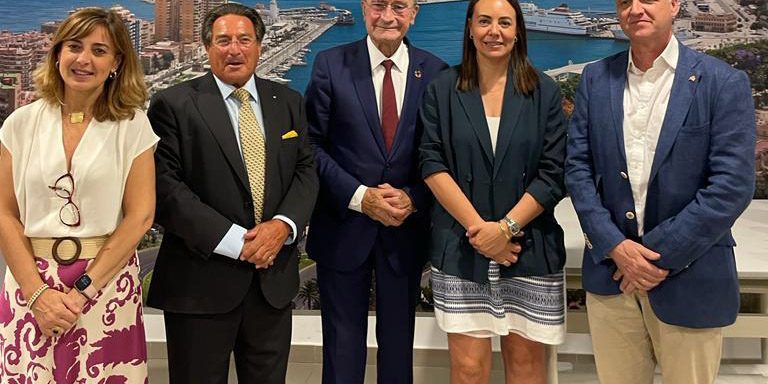
Today we are excited to announce the launch of the 8th British Investment Barometer in Spain, which took place in Malaga. In this outstanding event, we are proud to have our company, Miriem Diouri García, as a speaker.


The British Investment in Spain Barometer is a fundamental tool for understanding the evolution of British investment in our country and its impact on the economy. As an active player in the business advisory industry, MDG Advisors is honored to participate in the launch of this report.

The presence of our company, Miriem Diouri García, as a speaker, reinforces our commitment to rigorous analysis and the exchange of knowledge in the field of British investment in Spain.

We thank all attendees for joining us in this important presentation and for the opportunity to continue collaborating with the business and financial sector in the future.

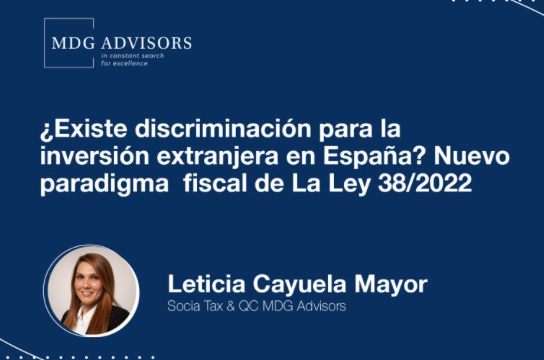
Is there discrimination against foreign investment in Spain? New tax paradigm of Law 38/2022

Law 38/2022, of December 27, 2002, brought important regulatory changes affecting the taxation of non-resident companies in Spain.


The first aspect to highlight would be the implementation, already for the financial year 2022, of the Temporary Solidarity Tax on Large Estates, hereinafter referred to as ITSGF.


This new tax, with which we should familiarise ourselves, is a direct, personal and complementary tax to the Wealth Tax, which is levied on the net wealth of individuals with a value of more than Euros 3,000,000.


So far, both resident and non-resident taxpayers in Spain will have a new tax obligation with the Spanish tax authorities in July.
But what happens with the Euros 700,000 exemption established in this tax? Well, this is where the possible “discrimination against non-residents in Spain” who have invested or intend to invest in our country comes into play, as the tax base will only be reduced by Euros 700,000 in the case of personal obligation. In other words, this reduction of Euros 700,000 CANNOT be applied to non-resident taxpayers in Spain, which could be a discrimination contrary to Community provisions.


However, what happens with the taxation limit for this tax? The full amount of this tax, together with the amounts of Personal Income Tax and Wealth Tax, may not exceed, for taxpayers subject to the tax by personal liability, 60% of the sum of the taxable bases of the former. Again, another limit, but only for the personal liability: what happens to those who are taxed under the real liability (non-residents in Spain)?


And, finally, we will deal with the criterion of personal and real obligation, a subject that serves as a prelude to comment on another regulatory change brought about by Law 38/20222, of 27 December. In the third final provision of the aforementioned Law, the Wealth Tax is modified, also for the financial year 2022.


With this amendment, who are the taxable persons for wealth tax from 2022 onwards, and therefore for the ITSGF?


  • By personal obligation, individuals who have their habitual residence in Spanish territory, with the tax being levied on the totality of their net wealth regardless of where the assets are located or where the rights can be exercised.
  • By real obligation, any other natural person for the assets and rights they own when these are located, may be exercised, or must be fulfilled in Spanish territory.
     MODIFICATION: For these purposes, securities representing equity interests in any type of entity, not traded on organised markets, at least 50% of the assets of which are directly or indirectly made up of real estate located in Spanish territory, shall be deemed to be located in Spanish territory.


In the recent resolution of the DGT consultation V0107-23, dated 1 February 2023, it was established that, with the new regulatory change, a non-resident in Germany, partner of a German company, holding a real estate property in Ibiza valued at 7,500,000 Euros, whose value means that at least 50% of the company’s assets are made up of real estate located in Spanish territory, will be taxed in Spain for all of the company’s assets, AND NOT only for the real estate in Spain.


This conceptual modification to the real tax obligation leads us to consider this “new concept” of real obligation as a hybrid between being a taxpayer by personal and real obligation, since, if the non-resident company has assets, at least 50% of which are made up, directly or indirectly, of real estate located in Spanish territory, it will have to pay tax in Spain on all the company’s assets, even if it is a non-resident company.


Due to the importance of foreign capital in our country, both the ITSGF and the new modification of the Wealth Tax have already been denounced before the European Commission. There is nothing left to do but wait for the resolution of this complaint, and in the meantime, we will be happy to analyse each specific case of our clients.

Collaboration agreement with SIMED

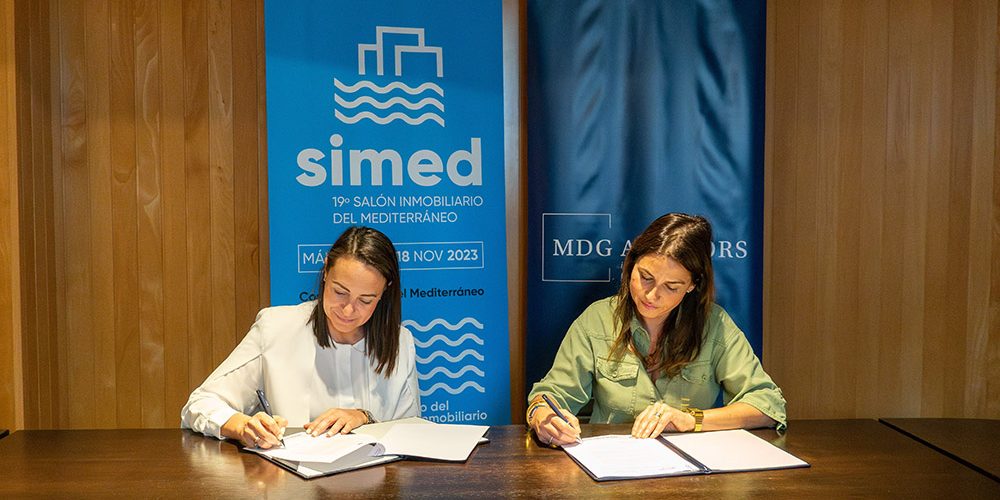
MDG Advisors is pleased to announce its collaboration agreement with SIMED, the Mediterranean Real Estate Exhibition, which will take place from November 16 to 18, 2023 at FYCMA, Malaga Trade Fair and Congress Center. SIMED is recognized as a key meeting point for professionals, companies and potential buyers and sellers in the real estate sector. We are excited to be able to contribute our experience and knowledge to this event and establish new business relationships.

Towards the digitisation of notarial services.

Last Tuesday, 9 May, the new Law 11/2023, of 8 May, was published in the Official State Gazette (BOE), which includes important new features in the way of relating with notaries and carrying out procedures before these professionals.

With the effects of the aforementioned Law and expected by the end of the year, the digitalisation of notarial procedures will take place, allowing this type of service to be provided online, without the need for the interested party to go to the notary in person. The procedure could be carried out by videoconference and the signing of the document would be carried out by specialised platforms that guarantee the authenticity of the signature, safeguarding the security of the information with important measures.

It should be borne in mind that this law is the transposition of a European directive, so that these new developments in the digitalisation of procedures before the notary would represent a further step in the bureaucratic integrity of the European Union, with a citizen of one Member State being able to carry out a procedure (incorporation of a company, legitimisation of a signature, power of attorney, cancellation of guarantees, etc.) in another Member State without the need to travel.

In conclusion, the digitalisation of this type of actions, and bearing in mind the recommendations established by the Directive itself on money laundering and the fight against tax evasion, will be an important technological advance that will allow greater freedom to be given to the market itself by eliminating bureaucratic barriers and travel at the time of carrying them out, as well as a reduction in the environmental impact.

We will have to keep an eye on future news on this issue to know exactly when these technological developments will take place.

MDG Asesores joins the fiscal debate at the XVI National Study Day AEDAF

MDG Asesores, represented by partner Leticia Cayuela, member of the national group of young experts, participated in the XVI National Study Day AEDAF, an essential event for all tax and fiscal professionals.

The conference covered topics of great relevance in the current panorama, such as the information obligations of intermediaries derived from DAC6, the new European directive on corporate sustainability information, the response to information requirements in verification procedures and its fit in the situation of verified versus investigated and the right to remain silent in the inspection procedure, the implementation of the Temporary Solidarity Tax on Great Fortunes and the novelties introduced by the Law on the Promotion of the Emerging Business Ecosystem and the Law on the Creation and Growth of Companies, covering mercantile and tax aspects.

Undoubtedly, this conference was a unique opportunity to update knowledge and stay up-to-date with the latest legislative and fiscal developments, as well as to exchange ideas and opinions with other experts in the sector.

MDG Asesores’ presence at this event is a testament to the firm’s commitment to providing its clients with a high-quality service based on a deep knowledge of legislation and constant updating of regulatory changes.

In conclusion, the XVI National Study Day AEDAF was a resounding success and MDG Asesores, through the participation of Leticia Cayuela, once again demonstrated its leadership in the tax and fiscal sector.