admin

Economic activity of leasing for tax purposes.

Unlike other economic activities, property rental has been subject to certain requirements in order to be considered as such for tax purposes, which we will discuss below.

For Income Tax, according to Article 27 of the LIRPF, property rental is considered an economic activity when it is carried out by at least one person employed under a full-time employment contract. However, it is worth noting that it will be necessary to prove to the Tax Agency that the employee has a sufficient workload. Currently, the legislation is more permissive, no longer requiring the need to have premises used exclusively for the management of the rental of the property.

Therefore, if the aforementioned requirement is not met, the income obtained from the lease would be declared in the income tax return as income from real estate capital, in addition to being taxed for imputation of income for the period of the year not rented, while if it is met, it would be taxed for economic activities.

In relation to Corporate Income Tax, currently, in accordance with Article 5 of the LIS, the legislation requires the same measures as the previous tax, while in Value Added Tax, without the need for any additional requirements, the leasing of real estate is considered in itself an economic activity. This can be seen in Article 5 of the LIVA, which states, among the concepts of entrepreneur, “those who carry out one or several supplies of goods or services that involve the exploitation of a tangible or intangible asset with the aim of obtaining continuous income over time”.

On the other hand, it will be particularly relevant in Wealth Tax and Inheritance and Gift Tax whether or not the leasing of real estate is determined as an economic activity in Personal Income Tax, given that it will allow access or not to certain tax benefits in certain autonomous communities, such as the 99% reduction in Inheritance and Gift Tax in the Autonomous Community of Andalusia, for holdings in family businesses.

The latter demonstrates the importance of good tax planning to optimise the future tax burden, which is why, from our office, we advise you to consult a professional to study your case.

Isabel María Diaz Rubio.

Equalisation between non-residents and residents in Spain/Filing deadline for rental of real estate

After an intense month of January in professional offices, it ended with a pleasant surprise for non-resident taxpayers in Spain, with the introduction of modifications to the ministerial orders that approve the self-assessment forms 123, 210, 216, by means of Order HDA/56/2024, of 25 January, published in the BOE on 31 January 2024.


As a prelude to the explanation of the changes introduced by Order HDA/56/2024, of 25 January, it is worth reviewing the entire methodology of Form 210. This form must be used to declare any type of income obtained by a non-resident taxpayer (income, imputed income from real estate, and capital gains).


This form can be used both to declare each accrual of income separately and to declare several items of income obtained in a given period as a group, in accordance with the following rules:


  1. a) Income derived from transfers of real estate: Each accrual of income shall be declared separately. Exceptionally, when the property transferred is jointly owned by a married couple in which both spouses are non-residents, a single self-assessment may be made. In the case of losses, this self-assessment must also be submitted if you wish to exercise your right to a refund of the withholding that has been made.


  1. b) Rest of income: Several incomes obtained by the same taxpayer may be grouped together provided that they correspond to the same income type code, they come from the same payer, the same tax rate is applicable to them and, in addition, if they derive from an asset or right, they come from the same asset or right. However, in the case of income from rented or sublet property not subject to withholding tax, it may be grouped together with the same requirements except for income from the same payer, although when declaring income from property from several payers it will be necessary to indicate a specific code for the type of income, 35 (income from property not subject to withholding tax with grouping of payers).


Under no circumstances may the grouped income be offset against each other.


Having set out all the information related to Form 210, it is worth mentioning the modification that affects non-resident taxpayers, introduced by Order HDA/56/2024, of 25 January. This modification is related to the deadline for filing Form 210 for the lease or sublease of real estate rented by a non-resident taxpayer.


As from 2024, non-resident taxpayers with property rented in Spain will be able to file annually from 1 to 20 January of the following year, instead of continuing to do so on a quarterly basis, as they had been doing until the aforementioned modification. In other words, in the case of annual grouping of income derived from the lease or sublease of real estate, accrued from 1 January 2024, the filing period will be from 1 to 20 January of the year following the accrual year, i.e. from 1 to 20 January (15 January if the tax is to be paid by direct debit) of the 2025 tax year.


In this way, the discrimination that non-resident taxpayers in Spain had to file Form 210 on a quarterly basis is eliminated, with respect to a tax resident in Spain, who does so on an annual basis, for the same taxable event (the leasing or subleasing of real estate).


Leticia Cayuela Mayor.

Transfer of shares in a company owning real estate: commercial and tax implications, problems and effects

The sale of companies whose assets consist of real estate should, from a commercial and tax point of view, be studied in detail in accordance with the regulations in force, as otherwise it could be classified as tax avoidance by avoiding the legal transaction of the sale and purchase of the real estate in question.

Firstly, from a commercial point of view, it should be noted that the transfer of company shares is regulated in article 106 et seq. of the Capital Companies Act (LSC), which establishes the obligation to notarise the transfer of company shares; however, the Supreme Court ruling of 5 January 2012 establishes that the requirement to notarise the transfer will not be a constitutive requirement, but rather will confer evidentiary value and publicity value to the transfer.

From the point of view of taxation, we must differentiate whether we are dealing with the condition of transferor or acquirer:

In the case of the transferor of the shares, we must bear in mind that, as it is a company, he/she will incur a capital gain or loss which will be included in the taxable base for corporation tax.

On the other hand, in the case of the acquirer of the shares, Article 45. I, B, 9 of Royal Legislative Decree 1/1993, of 24 September, approving the revised text of the Law on Transfer Tax and Stamp Duty (TRLITPAJD) establishes that “transfers of securities, whether or not they are admitted to trading on an official secondary market, shall be exempt (…) in accordance with the provisions of Article 108 of Law 24/1988, of 28 July, on the Stock Market”.

Similarly, Article 314. 1 of the Securities Markets Law (LMV) exempts the transfer of securities, both from the point of view of ITP and VAT; However, the second paragraph of the aforementioned article states that “transfers of securities not admitted to trading on an official secondary market carried out on the secondary market are exempt from the provisions of the previous paragraph, which will be subject to the tax to which they are subject as transfers of real estate for valuable consideration, when such transfers of securities are intended to avoid payment of the taxes that would have been levied on the transfer of the real estate owned by the entities to which the securities represent”.

In this regard, the Directorate General for Taxation establishes in its CV V0096-19 the concurrence of three requirements for the application of the NON-exemption:

1.- That it is a transfer of securities carried out on the secondary market, which excludes the acquisition of newly issued securities, which would take place on the primary markets.

2.- That the securities transferred are not admitted to trading on an official secondary market, which excludes transfers of securities admitted to trading on such a market (without prior temporary admission requirement).

3.- The intention or intention to evade payment of the taxes that would have been levied on the transfer of the real estate owned by the entities to which these securities represent (animus defraudandi), which is a question of fact that cannot be determined a priori by this Management Centre, but must be sufficiently proven by the tax administration responsible for the management of the applicable tax.

The question we could ask ourselves is: in what cases does one act with the intention of avoiding payment of the corresponding tax? Article 314 of the LMV itself provides an answer to this question and establishes that, unless there is proof to the contrary, it will be understood that there is an intention to avoid payment when:

(a) Control is obtained over an entity at least 50 per cent of whose assets consist of real estate located in Spain that is not assigned to business or professional activities, or when, once that control has been obtained, the shareholding in it increases.

  1. b) Control is obtained over an entity whose assets include securities that enable it to exercise control over another entity at least 50 per cent of whose assets consist of real estate located in Spain that is not involved in business or professional activities, or when, once this control has been obtained, the shareholding in it increases.
  2. c) The securities transferred have been received for contributions of real estate made when companies are incorporated or their share capital is increased, provided that such assets are not used for business or professional activities and that no more than three years have elapsed between the date of contribution and the date of transfer.

Thus, it should be borne in mind that the presumption that at least 50% of the company’s assets are not assigned to an economic or business activity cannot be proven otherwise, since the requirements set by the legislator are specific and will be analysed in a later article. Otherwise, there may be other types of presumptions where it would be necessary to make allegations, but it will be up to the competent tax administration to prove the intention to avoid payment.

In summary, and in the case of this type of operation, it is essential to seek advice in order to avoid any type of regulatory risk which, as we have analysed, is not trivial in the case of transfers of shares in companies whose assets are made up of real estate.

At MDG Advisors we have a specialised team that will advise you in detail to your personal situation in order to obtain the best result for your needs.

Jesús Raya Zamora.

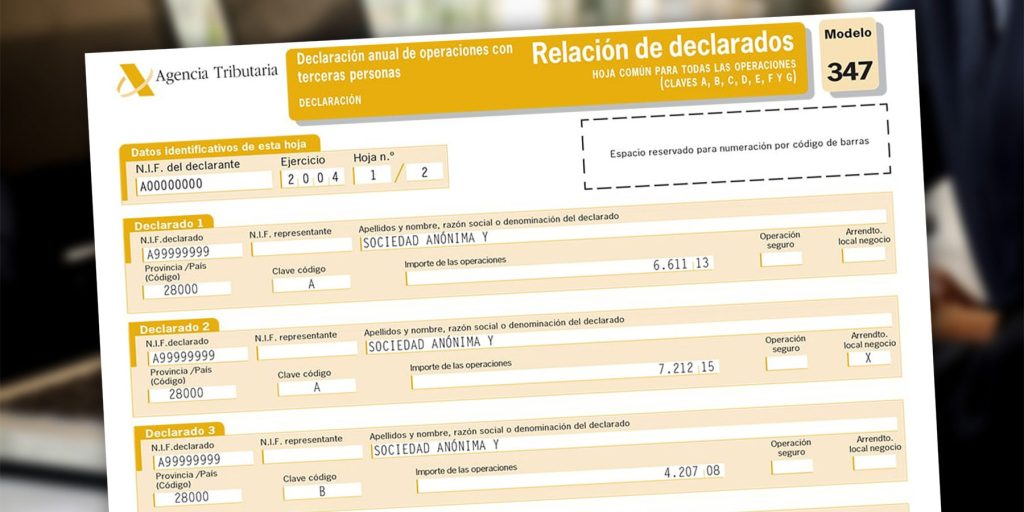
Form 347: Characteristics, obligations and recommendations

After a turbulent month of January fiscally speaking, February arrives bringing with it the Annual Informative Declaration of Transactions with Third Parties, which is filed by filling out Form 347. This form must detail the commercial transactions carried out with third parties during the previous fiscal year.

This informative declaration has annual character and is presented during the month of February, concluding the term of presentation corresponding to the fiscal year 2023, the next 29th.

The obligation to file Form 347 arises when the total amount of transactions, including taxes, exceeds €3,005.06 and, when calculating this limit, it is essential to accurately separate deliveries and acquisitions of goods and services, which are declared quarterly.

The responsibility for filing this return falls on individuals and companies that carry out business or professional activities, as established in the Value Added Tax Law. This includes communities of property under horizontal property regime, social entities and those who charge fees or rights on behalf of their associates.

However, there are exceptions and, among other circumstances, those operating outside Spain, individuals under specific tax regimes and those who do not exceed certain transaction limits may be exempt. Also excluded are those who keep electronic books through the electronic office of the State Agency of Tax Administration (Agencia Estatal de Administración Tributaria).

They are also excluded from the obligation to be declared:

  • Deliveries of goods or provision of services for which taxpayers are not required to issue and deliver invoices.
  • The operations that have been previously declared in other informative declarations, as it is the case of the operations declared in the Forms 180 and 190.
  • Transactions involving the delivery of goods to third countries (imports and exports of goods). However, those of services must be declared.
  • In case of a transaction with inversion of the taxpayer (acquisition of services from third countries), the corresponding box must be checked.
  • Deliveries and acquisitions of goods between the Spanish mainland or the Canary Islands, Ceuta or Melilla.
  • Deliveries of goods subject to VAT (exempt and non-exempt) must be declared separately.
  • The operations declared in the Form 349 (informative declaration of intracommunity operations).

Regarding the ways of filing Form 347, the Tax Agency distinguishes between individuals who may file their return with advanced electronic signature or using the signature system with access key in a previous registration as a user (Cl@ve PIN), while taxpayers attached to the Central Delegation of Large Taxpayers, legal entities and entities without legal personality, are required to file electronically by means of advanced electronic signature.

In summary, the Annual Declaration of Operations with Third Parties is a complex tax process that requires attention to ensure the accuracy of the declaration of business operations of the previous year, since it is necessary to analyze in detail the casuistry in each specific case. If you need more information about this declaration, do not hesitate to contact MDG Asesores and our tax team will be pleased to assist you.

Sandra Gámez Chaves

Modification of the rebate applicable to Wealth Tax in Andalusia

The publication of Law 12/2023, on the Andalusian Budget for 2024, has brought with it relevant modifications to the 100% regional rebate on the Wealth Tax (IP), introduced by Decree-Law 7/2022, which led to tax residents in Andalusia not paying this tax in 2022.

However, with the entry into force of the Solidarity Tax for Great Fortunes approved through Law 38/2022, of 27 December, it led to IP taxpayers in Andalusia with a wealth of more than 3.7 million euros to pay this tax.

All this has forced the Andalusian government to reform the regulation. This reform is contained in the new Transitional Provision 5 of Law 5/2021.

Transitional Provision 5 of Law 5/2021 introduces significant changes to the allowances applicable to Wealth Tax in Andalusia. Firstly, it establishes that, during the term of the ITSGF, Andalusian taxpayers have the option to choose between two types of relief, both of which are mutually incompatible.

The first option allows taxpayers to apply a rebate determined by the difference between the full amount of the Wealth Tax and the joint limit established by the regulations corresponding to the ITSGF, in accordance with the provisions of the State Law. This choice implies that the revenue generated by the tax remains in the Treasury of the Junta de Andalucía.

The second option consists of maintaining the 100% rebate on the full amount of the Wealth Tax, as previously established. However, in this case, taxpayers will be obliged to declare and contribute to the ITSGF, and the collection corresponding to this tax will be directed to the State Treasury.

Opting for either of the two alternatives does not result in any increase in the tax burden for the taxpayer, but simply changes the destination of the tax payable.

Sara Gámez Córdoba.

Updates to Form 149: Special Regime for Workers Posted to Spanish Territory or “Beckham Law”

In previous blog posts, we have mentioned the main modifications to the Special Regime for Workers Posted to Spanish Territory and since 15 December 2023 the new format of Form 149 has been approved by the Spanish Tax Agency, to accommodate the new groups that can access the so-called Beckham Law from 1 January 2023 (Law 28/2022).

Form 149 is a form used in Spain to communicate the option of taxation under the special regime applicable to workers posted to Spanish territory. This form must be submitted by taxpayers wishing to exercise this option.

For the purposes of reporting the main changes, two main concepts come into play: main taxpayer or associated taxpayer. In the case of a principal taxpayer, he has a period of six months from the date of commencement of the activity as stated in the registration with the Social Security in Spain or in the supporting documentation. In the case of associated taxpayers, six months from the date of their entry into Spanish territory or within the previous period foreseen for the main taxpayer, whichever is longer.

This modification is reflected in the first section of Form 149, in which, from 15 December 2023, a box with the option Main taxpayer or Taxpayer associated with another main taxpayer can be ticked. The different options that each of them can use are indicated in the fourth section of the form, which is broken down into section A for all the options that can be considered by the main taxpayer and section B for all the options that can be considered by the associated taxpayer.

The new options for the main taxpayer related to being an employee are the following:

-Initiation of employment relationship with Spanish employer.

-Posting ordered by employer with posting letter.

-Displacement not ordered by the employer, of a teleworker.

Likewise, there are new options for the taxpayer if he/she is a director of an entity, which with the new modification, there are two different options: director of an entity and director of an asset-holding entity of article 5.2 LIS.

In the following sections, the modifications to the main taxpayers are extended to include the following new groups:

– Those who move to develop an entrepreneurial activity under the terms of Law 14/2013, of 27 September, on support for entrepreneurs and their internationalisation.

-Highly qualified professionals who provide services to emerging companies.

– Those who carry out training, research, development and innovation activities and meet certain requirements.

On the other hand, section B offers the modifications made to Form 149, of options for associated taxpayers, such as the ability to include the taxpayer’s children under the age of twenty-five (or whatever their age in the case of disability) and their spouse or, in the event of there being no marital relationship, the parent of the children.

Finally, we should point out that the Spanish Tax Agency establishes a period of six months to make the necessary modifications and to allow all those who could not apply for this law to do so at the time. Likewise, the communication of the renunciation of the application of the special regime will take place during the months of November and December. When a main taxpayer has communicated its renunciation or exclusion, it will not be necessary for the associated taxpayers to communicate this to the Tax Administration.

Should you have any queries about the options for applying the impatriate regime, our office is at your disposal.

Carmen Moya López.

The Beckham Law and its latest amendment to the Personal Income Tax Regulations

As we have commented in previous publications, the special regime for workers posted to Spanish territory, better known as the Beckham Law, has undergone modifications following the publication of Law 28/2022, of 21 December, on the Promotion of the Start-up Ecosystem, which have led to the relevant corrections in the Personal Income Tax Regulations. Below we will analyse the most noteworthy modifications.

The inclusion of new cases of application to the regime is one of the modifications, going into more detail on the requirements necessary to qualify for each one of them and shedding some light on questions such as, could my activity be considered as entrepreneurial, am I a highly qualified professional, am I a highly qualified professional, etc.?

On the other hand, the adaptation of the duration of the regime to the taxpayers associated with the main taxpayer, these being the spouse and their children under the age of 25 or with disabilities, or the parent in the event that there is no marital relationship.

Likewise, the individual notification by each taxpayer to apply the system, with a period of six months from entry into Spain for associated taxpayers or the period of the main taxpayer if this is longer. The situation existing at the time of applying for the regime will be taken into account to establish whether the requirements of age, disability and relationship between the main taxpayer and the associate are met.

Another modification to be highlighted is the possibility of individual renunciation by associated taxpayers in the same terms and conditions as previously foreseen. However, the renunciation or exclusion of the main taxpayer will also tacitly exclude them from the system, as well as if they fail to comply with any of the conditions.

All the changes detailed above have been introduced prior to the approval of the new Form 149, which we will discuss in one of our next publications. This has resulted in a number of taxpayers who met the requirements being ineligible for the regime, which is why an implementation period of six months has been established from its entry into force.

If you need any help to qualify for the impatriate regime, our firm is at your disposal.

Isabel María Diaz Rubio.

Optimising the financial structure of a company: Tax advantages of increasing shareholders’ salaries or distributing dividends and how they compare in terms of personal income tax and corporate income tax.

In the business world, strategic financial decision-making plays a crucial role in the success and sustainability of a company and must also be in line with the requirements of tax compliance and corporate compliance. Among the options available to managers for the improvement of remuneration by the company are an increase in their own salary, provided that this is not linked to remuneration for their directorship, or the distribution of dividends. Beyond the economic and employment implications, it is essential to analyse the tax advantages associated with each of these decisions.


Increased salaries for partners: Tax implications and advantages.

Increasing salaries for a firm’s partners can offer several tax advantages that contribute to sustainable growth and financial strength.

Firstly, the salary, for corporate tax purposes, is considered a deductible expense, which reduces the company’s taxable base, and always bearing in mind whether the salary is received for work performed by the partner himself or for remuneration as a director, in which case, there would be some specifications to take into account. In either case, this tax deduction can be significant, as it decreases the entity’s overall tax burden.

In addition, higher salaries may generate additional benefits by increasing contributions to social security and retirement plans.


Dividend payouts: Optimising accountability to shareholders.

In contrast to salary increases, dividend distributions also have key tax advantages that can influence a company’s financial decisions; however, it should be noted that there are a number of corporate requirements to be complied with, such as those set out in Articles 274 and 275 of the Spanish Companies Act (Ley de Sociedades de Capital):

  • After the distribution of dividends, there must not be an equity imbalance, i.e. the net assets of the company must not be less than the share capital.
  • In the event of losses from previous years, the profit must be used to cover such losses.
  • 10% of the profit must be allocated to the legal reserve.

On the other hand, the dividend distribution policy can also be beneficial in terms of tax flexibility. By allocating dividends, the company can adapt its profit distribution structure according to its objectives and market conditions. This allows for more agile and efficient management of financial resources, especially in volatile economic environments.


Strategic considerations for sound decision making: Tax efficiency in the area of personal income tax and corporate income tax.

The choice between increasing salaries or distributing dividends should not be based solely on tax advantages. Factors such as the company’s financial situation, long-term goals, talent retention and shareholder perception should be carefully considered.

As far as personal income tax (IRPF) taxation is concerned, it should be borne in mind that salary will be taxed as employment income in the general tax base at a maximum rate of 47%. On the other hand, dividends will be taxed as income from movable capital in the savings base at a rate of 19/28%.

Likewise, and as already indicated, as far as corporate income tax is concerned, the salary, and provided it is not remuneration for the position held as a director for which certain requirements must be met, will be deductible in corporate income tax, whereas dividends will not produce a saving in corporate income tax.


In conclusion, both salary increases and dividend distributions offer valuable tax advantages for companies and their shareholders. It is crucial to conduct a cost-benefit analysis that includes not only the short-term tax implications, but also the long-term impact. In many cases, a balanced combination of both strategies may be the most prudent option.


Jesús Raya Zamora.

New regulation approved: computerised invoicing requirements

Recently, on 6 December, Royal Decree 1007/2023 of 5 December was published in the Official State Gazette (BOE), approving the Regulation that establishes the requirements to be adopted by the computer or electronic systems and programmes that support the invoicing processes of entrepreneurs and professionals, and the standardisation of invoicing record formats.

This new regulation came into force on 7 December, and taxpayers must have the computer systems adapted to the characteristics and requirements in place by 1 July 2025, so the following is a summary of the main points to bear in mind before the end of this period:

  1. To whom does this new regulation apply?

– Corporate taxpayers.

– Taxpayers of personal income tax who carry out economic activities.

– Non-resident income taxpayers who obtain income through a permanent establishment.

– Entities under the system of attribution of income that carry out economic activities, without prejudice to the attribution of income that corresponds to their members.

It shall also apply to the producers and marketers of computerised invoicing systems, in matters relating to their respective activities of production and marketing of the computerised systems made available to taxpayers.

Exception: It will not apply to taxpayers who keep their books of records through the AEAT’s Electronic Headquarters by means of the electronic supply of invoicing records (SII).


Nor will it apply to certain operations such as the following:

– Those under the special VAT regime for agriculture, livestock and fishing.

– Those carried out by entrepreneurs or professionals in the course of their activities to which the special equivalence surcharge regime applies or those under the simplified VAT regime.

– Those related to certain deliveries of electrical energy or those invoiced by the National Energy Commission.

– Those documented in invoices for transactions carried out through permanent establishments abroad.


  1. What is the main change in the Billing Regulation?

The purpose of this new regulation is really to regulate the requirements and technical specifications that the computer systems used by those who carry out economic activities must comply with when carrying out invoicing processes. In other words, the computerised invoicing systems used by taxpayers must comply with a new series of requirements in order to be considered valid and to correctly transmit the information contained in them. Above all, the regulation establishes that the computer systems must guarantee the integrity, conservation, accessibility, legibility, traceability and unalterability of the invoicing records.

Furthermore, the computer system must be capable of sending the tax administration, by electronic means, all the invoicing records generated, continuously, securely, correctly, fully, automatically, consecutively, instantaneously and reliably, and must have an event log that automatically records, at the time they occur, certain interactions with the computer system, operations carried out with it or events occurring during its use, storing the data corresponding to each of them, which must be able to be consulted from the computer system itself.

In the computer systems, access to information with tax implications shall be duly dissociated from access to possible confidential information of a non-property nature, so that the tax administration may have direct access to the consultation and the rest of the functionalities required for the information in the invoicing and event records.

  1. What computer system can be used with this new regulation?

Taxpayers may comply with the new obligations using the following options:

– An own computer system, which must have a responsible declaration certifying that said computer system complies with the regulation, among other requirements.

– The computer application that the Tax Administration may develop for this purpose.


You can find more information at the following link:        https://www.boe.es/boe/dias/2023/12/06/pdfs/BOE-A-2023-24840.pdf

If you have any doubts about these new invoicing obligations, please do not hesitate to contact MDG Advisors.


Marina Guerrero Castronuño

The Tax on Economic Activities and its census obligation in the month of December

Most of us tax advisors are working on the annual accounting and tax pre-closing of companies in order to be able to offer our clients the best tax advantage to reduce their tax burden for the financial year 2023.

However, in view of this workload, we cannot forget that during the month of December there is a new census obligation to comply with and to communicate any variation in the Tax on Economic Activities. This notification must be made to the Tax Agency (Form 840) or to the City Council (Form 010) where the company has its tax domicile, depending on the powers of each Administration.

Before going into the tax obligations to be filed with the Census, we would like you to familiarise yourselves with the tax to be dealt with:

The Tax on Economic Activities (hereinafter, IAE), which is regulated in articles 78 to 91 of Royal Legislative Decree 2/2004, of 5 March, which approves the revised text of the Law Regulating Local Treasuries, is a tax levied on the exercise of business, professional or artistic activities in Spanish territory.

It is a local tax that is applied at municipal level and is managed by the local councils. It is worth mentioning that not all activities are subject to IAE, and there are exemptions and bonuses applicable in many cases.

Some key points to highlight about the IAE:

– Scope of application: individuals or legal entities and the entities referred to in Article 35.4 of Law 58/2003, of 17 December, General Tax Law, which carry out business, professional or artistic activities in Spanish territory, are taxable persons subject to this tax.

However, it should be borne in mind that individuals, whether or not they are resident in Spanish territory, are exempt from the tax.

– Rates: IAE rates vary according to the nature of the activity and the net turnover. There are specific headings that classify activities, and each one has an assigned rate.


– Exemptions and allowances: There are activities that are exempt from IAE, and in some cases, local councils can establish reductions in the tax rates.

With regard to exemptions, the following two are worth mentioning:

  1. Taxpayers who start their activity in Spanish territory are exempt during the first two tax periods of this tax in which they carry out their activity.
  2. Corporate taxpayers, civil companies and the entities of article 35.4 of Law 58/2003, of 17 December, General Tax Law, are exempt provided that they have a net turnover of less than 1,000,000 Euros.


– Municipal management: Although it is a national tax, it is managed by the local councils. Each municipality establishes the specific rates and conditions, within the limits set by national legislation.


– Self-assessment: This is where the census obligation that we mentioned at the beginning of the article falls.

IAE taxpayers must submit a census declaration during the month of December (form 840 or form 010, depending on the jurisdiction of each territory) in which they notify the competent body of any event that entails, with effect for the financial year 2024, the cancellation or registration in said tax.

The following is a brief example that summarises the procedure to be carried out:

A company that is not newly created, and during the financial year 2021 had a net turnover of 750,000 Euros and during the financial year 2022 this figure increased to 1,250,000 Euros, is obliged to notify, by means of Form 840 or 010, that it no longer enjoys the exemption established in article 82.1.c) of the Royal Decree mentioned at the beginning of the article, with effect for the financial year 2024. This census notification must be made in December2023.

The range of possibilities for this tax is very wide depending on the type of each client and the activity to be carried out, so if you would like further information on this article, we remain at your disposal to clarify any doubts you may have in this respect.


Leticia Cayuela.