
admin

VAT and Travel Agencies: What You Need to Know About the Special Scheme

The Value Added Tax (VAT) is one of the pillars of the Spanish tax system. It is an indirect tax on consumption that applies to most goods and services supplied by businesses and professionals within Spanish territory. This extensive and complex tax operates in a coordinated manner across the European Union, based on a system of deductions that ensures the tax is ultimately borne by the final consumer.

Within VAT legislation, there are several special schemes designed to simplify taxation in specific sectors. These include the Surcharge on Equivalence Scheme, the Special Scheme for Used Goods, and the Agriculture, Livestock and Fisheries Scheme, among others. One of the most unique and frequently misunderstood is the Special Scheme for Travel Agencies (REAV), which is highly relevant for advisers, travel agencies and tourism professionals because it operates very differently from the general VAT system.

This REAV is regulated in Articles 141 to 147 of the Spanish VAT Law (LIVA) and must be applied whenever a travel agency acts in its own name. This means the agency uses goods or services provided by other businesses or professionals—such as hotels, transport providers or activities—to organise the trip and assumes responsibility for the overall service, regardless of whether it operates online or has a physical office. Conversely, when the agency acts solely as an intermediary or uses only its own means and charges a commission, the general VAT scheme applies.

The most distinctive feature of the REAV is that the VAT taxable base is not calculated on the total price of the trip but on the margin obtained by the agency:

Margin = Price charged to the customer – Cost of services purchased from third parties

Because the margin is the taxable base, the agency does not need to analyse the VAT applicable to each individual service included in the package. For this reason, the agency cannot deduct the VAT on services intended directly for the travelers such as hotels, meals, or tickets—as these form part of the trip’s cost and therefore affect the margin calculation. This system is particularly useful for international travel, where numerous providers and different tax rules are involved.

However, the agency may deduct VAT on expenses related to its own business activity, such as office rent, software or supplies.

Another important feature of the REAV is that invoices do not need to show the VAT amount separately. The tax is included in the final price. This may cause confusion for business clients, who are often unable to deduct this VAT because of the nature of the scheme.

We must also mention the exemptions set out in Article 143 of the LIVA, which states that travel services provided outside the European Union are exempt from VAT. If a trip includes parts both inside and outside the EU, only the portion carried out outside the EU benefits from the exemption. This rule is especially advantageous for international travel, as it reduces the final cost for the customer and further simplifies margin calculations.

Conclusion

The Special Scheme for Travel Agencies greatly simplifies taxation in a sector involving multiple service providers and international operations. Understanding how margin calculation works, which VAT can be deducted, and how the exemption in Article 143 applies is essential for correctly applying the scheme and avoiding errors.


Taxation of the sale of shares in Value Added Tax and Property Transfer Tax. 

Beyond registration obligations and possible income tax liability, the question arises of taxation in Value Added Tax or Property Transfer Tax and Stamp Duty. To answer these questions, we must refer to Article 338 of Law 6/2023 on Securities Markets and Investment Services.

This article establishes that, as a general rule, the transfer of securities—whether or not they are admitted to trading on an official secondary market—is exempt from VAT and TPO/AJD. This measure seeks to promote the liquidity and efficiency of financial markets, preventing securities trading from being hampered by tax burdens that could discourage investment.

However, the rule introduces an important exception: when securities not admitted to trading on an official secondary market are transferred and the transaction is used to avoid taxation on real estate, the transfer will not be exempt. In this case, the transaction will be taxed as if it were a transfer of real estate for consideration. In this way, the legislator aims to prevent tax fraud, ensuring that securities transactions do not become a mechanism for avoiding the payment of taxes that would correspond to the purchase and sale of real estate.

Article 338 replaces the former Article 314 of the Consolidated Text of the Securities Market Law, maintaining virtually the same wording. It establishes several cases in which, unless proven otherwise, it is understood that the intention is to evade tax payments, which does not imply that there are no other cases not covered by the legislation. 

If you think you may find yourself in this situation and have questions about how you will be taxed, please do not hesitate to contact MDG Advisors, and we will help you resolve all your questions.


Dissolving a Company: The Distribution of Real Estate That Is Indeed Taxable.

The retirement of partners in small real estate companies often comes with the same dilemma: how to dissolve the company and distribute its properties without the tax authorities taking a significant portion of the accumulated wealth.
A recent binding ruling issued by the Spanish Directorate-General for Taxation (DGT) has examined this situation in detail, shedding light—and issuing warnings—for those facing a similar operation.

The consulting entity was a limited liability company engaged in real estate development which, for more than a decade, had confined its activity to renting out three apartments, without carrying out new developments or property sales. Upon the retirement of its three partners, each holding one-third of the share capital, the company planned to dissolve and allocate one apartment to each partner. The properties had similar values, making the distribution equitable.

At first glance, this might seem like a simple internal transfer of assets without any economic transaction. However, the DGT clarified that such a dissolution involving the distribution of assets gives rise to several tax obligations for both the company and its shareholders.

Corporate Income Tax

According to Article 17 of Law 27/2014 on Corporate Income Tax, when a company transfers assets to its shareholders—whether through dissolution, withdrawal, or capital reduction—it must value them at market price and record the difference from their book value as taxable income.

In other words, even if the company does not sell the properties on the market, it must be taxed as though it had done so at their fair market value. If the properties have appreciated since acquisition, that gain must be included in the taxable base for the liquidation year.

This makes dissolution a transaction with significant tax implications, particularly for long-standing companies holding real estate assets that have substantially increased in value.

Value Added Tax (VAT)

With respect to VAT, the DGT reminds that transfers of assets made by companies to their shareholders are considered subject to the tax, even when they occur upon cessation of business activity.

However, such transfers are exempt from VAT if they qualify as second or subsequent transfers of buildings, in accordance with Article 20.One.22 of the VAT Law.

In the case under review, the apartments had been rented for more than ten years, so the allocation to shareholders would be exempt.

Nonetheless, the law allows taxpayers to waive the exemption when the recipients are taxable persons with the right to deduct input VAT. In that event, the reverse charge mechanism applies, shifting the obligation to pay the tax to the shareholders receiving the properties.

Transfer Tax and Stamp Duty (ITPAJD)

In addition, the dissolution of the company is subject to the “corporate transactions” category of the Transfer Tax and Stamp Duty (ITPAJD), pursuant to Article 19 of the consolidated version of the law.

The taxable base will be the value of the assets allocated, without deduction of debts or expenses, and the applicable tax rate is 1%. The shareholders are liable for the payment of the tax corresponding to the assets they receive.

The DGT concluded that this type of transaction, though common among small family-run real estate companies, is not exempt from tax obligations.
The company must pay Corporate Income Tax on the latent capital gains of its properties, and the shareholders must bear the ITPAJD corresponding to the allocation.

In summary, dissolving a company and “dividing up the apartments” is not merely a change of ownership but a transfer with full tax consequences.

Practical Considerations

Therefore, dissolving a real estate company requires more than a simple accounting distribution: it demands a detailed tax review before executing any allocation.
Assessing the value of the assets, simulating the tax burden, and considering alternatives—such as a prior sale, merger, or maintaining the company—can help prevent costly surprises.


Tax myths in 30 seconds: Is it mandatory to have a Spanish partner to set up a limited company in Spain?

Many people believe that to set up a company in Spain, you must have a local partner. The reality is very different: you can create a single-member limited liability company, with just one partner, and that partner can even be a foreigner! You don’t need to be a tax resident or a Spanish citizen to start your business. This means entrepreneurs from anywhere in the world can invest and operate in Spain without unnecessary barriers.

That said, even if you don’t live in Spain, your company will have tax obligations in the country. For example, it must file corporate income tax. Additionally, if it conducts operations with non-residents, such as real estate transactions, you need to consider important details, like the 3% withholding on property sales, to avoid issues with the Spanish tax authorities.

The good news is that creating your company in Spain as a foreigner is completely possible. With the right information and proper tax planning, you can manage your company smoothly and take advantage of all the opportunities the Spanish market offers. You just need to plan carefully and ensure compliance with both the company’s tax obligations in Spain and your personal obligations in your country of residence.

Marc Sanderson: Málaga A Growing Tech Hub

Málaga has always been a strategic location for tech companies. Its excellent location and quality of life have attracted numerous software companies over the years, making it easier to attract talent and create jobs in the city.

The city hosts leading centers such as Vodafone in cybersecurity, the Google Safety Engineering Center, Digital programs for education in gaming and digital content, and the International Android Market Electronics Center, which will bring laboratories focused on microelectronics.

These initiatives position Málaga as a global and specialized tech hub, ready to continue playing a key role in the sector’s future.

Form 232: Informative Return on Related-Party Transactions and Transactions or Situations Involving Countries or Territories Classified as Tax Havens

During the month of November, companies must comply with an important tax obligation: the filing of Form 232, an informative return concerning related-party transactions and transactions or situations involving countries or territories classified as tax havens.

What is Form 232?

Until the 2016 fiscal year, this information was included in Form 200 of the Corporate Income Tax return. However, for tax periods beginning on or after January 1, 2016, the Spanish Tax Agency requires this information to be filed separately through Form 232, with the aim of improving control and transparency in transactions between related entities.

Filing Deadline

Form 232 must be filed within the month following the ten months after the end of the tax period.
For example, if the fiscal year ends on December 31, the filing period will be from November 1 to November 30 of the following year.

Who Is Required to File?

The following must file Form 232: corporate income taxpayers, non-residents with a permanent establishment, and entities under the income attribution regime constituted abroad but with a presence in Spain, provided they carry out any of the following transactions:

  • a) Transactions carried out with the same related person or entity when the total amount during the fiscal year exceeds €250,000, based on market value.
  • b) Specific transactions (*) carried out with related persons or entities, when the total amount of each type of such transaction during the fiscal year exceeds €100,000.
  • c) Transactions with related persons or entities of the same type using the same valuation method, when the total amount of such transactions during the fiscal year exceeds 50% of the entity’s net turnover.
  • d) Transactions in which the taxpayer applies the reduction on income derived from certain intangible assets provided for in Article 23 of the Corporate Income Tax Law, because income is obtained from the transfer of such intangibles to related persons or entities.
  • e) Transactions or holdings of securities in countries or territories classified as tax havens, regardless of the amount.

(*) The following are considered specific transactions:
(i) Those carried out by Personal Income Tax taxpayers engaged in an economic activity under the objective estimation method with entities in which they or their spouses, ascendants, or descendants hold, individually or jointly, 25% or more of the share capital or equity;
(ii) Transfers of businesses;
(iii) Transfers of shares or interests representing equity in entities not listed on regulated markets;
(iv) Transfers of real estate; and
(v) Transactions involving intangible assets.

Exemptions

The following transactions are exempt from reporting:

a) Transactions carried out between entities belonging to the same tax consolidation group.
b) Transactions carried out by Economic Interest Groupings (EIGs) and Temporary Business Associations (UTEs) (except when applying the regime established in Article 22 of the Corporate Income Tax Law).
c) Transactions carried out within the framework of public takeover bids or public offerings for sale.

Form 232 must be filed exclusively online, through the Electronic Headquarters of the Spanish Tax Agency (Agencia Tributaria).

The filing of Form 232 represents a key obligation for entities engaged in related-party transactions or those involving countries or territories classified as tax havens. Meeting this requirement accurately and within the established deadlines is essential to ensure transparency and proper compliance with tax obligations.

Sara Gámez Córdoba. 


How to plan the next fiscal year: the importance of anticipating the accounting year-end closing

November is a key month to anticipate the accounting year-end and plan the next fiscal period with confidence. At MDG Advisors, we recommend performing a preliminary accounting close to identify potential high results in Corporate Income Tax and make strategic adjustments in time.

A proactive approach, assessing investments, provisions, or tax incentives, helps optimize the tax burden while staying fully compliant with regulations. It is also essential to review income and expenses, ensure everything is properly documented, and plan liquidity to start the new year on solid financial ground.

Anticipating the year-end close is not only good practice but a strategic decision that provides stability, control, and a clear vision for the future. At MDG Advisors, we are ready to guide you through this process and help you make informed decisions that drive your business growth.

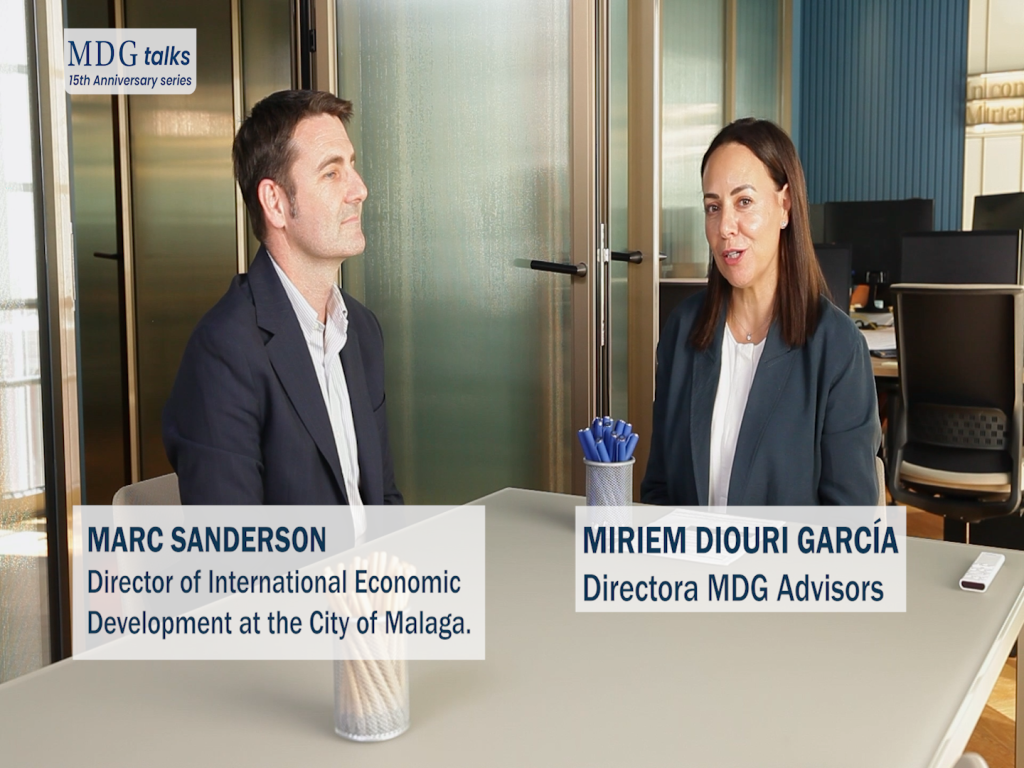
Marc Sanderson: “Málaga has something that captivates you and makes you want to stay”

At MDG Advisors, we’re celebrating 15 years of growth, connection, and shared success. Under the motto We Are the Light, we’re highlighting stories that shine a light on the people and partnerships that make Málaga a city of opportunity.

One of those voices is Marc Sanderson, Director of Invest in Málaga, who has played a key role in promoting the city internationally. During our talk, Marc shared how his initial goal of learning Spanish turned into a lasting love for Málaga.

“What truly captivated me was the experience of living here,” he said. “Málaga offers the benefits of a big city combined with natural beauty — the landscapes, the monuments, and, above all, its people. It’s a friendly, walkable city where it’s easy to feel connected.”

His words perfectly capture the spirit that drives us at MDG Advisors: an open, vibrant, and inspiring Málaga. After 15 years, we remain convinced that success is built on people — and on the passion to keep growing together.

The new Notary Portal: legal and tax implications for the property market.

The Portal de la Vivienda del Notariado, launched in October 2025 by the Spanish General Council of Notaries, marks a milestone in market transparency and legal certainty within Spain’s real-estate sector. The public platform (penotariado.com/inmobiliario) provides free access to real transaction data derived directly from notarised deeds, updated monthly and searchable by region, municipality or postal code.

  1. Reference value vs. market value

Until now, the “cadastral reference value” established under Spain’s General Tax Law (LGT) served as the minimum taxable base for Transfer Tax (ITP-AJD), Inheritance and Gift Tax (ISD), and related levies. Because it relied on statistical models rather than notarised transactions, it often triggered disputes between taxpayers and the administration.

With the Notarial Portal, advisors finally have empirical market evidence for defending property valuations, contesting administrative assessments, and substantiating capital gains or fair market values in corporate and personal income tax matters.

  1. Tax planning and compliance

The dataset—covering more than 170 million notarised documents—provides insights into:

  • Average €/m² by property type and region,
  • Buyer nationality (Spanish/foreign),
  • Year-on-year evolution, and
  • Socio-demographic patterns over the last 12 years.

These indicators enable precise estate and corporate tax planning. Advisors may rely on notarised data to determine fair market value in related-party transactions (art. 18 Corporate Tax Act), justify depreciation adjustments, or support valuations in mergers and reorganisations.

  1. Legal certainty and evidentiary value

Because the data originate from public deeds signed before a notary, they enjoy presumptive legal validity under Spanish civil and procedural law. Thus, they may serve as compelling documentary evidence in litigation, administrative reviews, or property-tax disputes—something that private portals cannot offer.

  1. Broader transparency impact

From a public-law perspective, the platform strengthens compliance with Spain’s Transparency Law 19/2013 and the EU’s Open Data Directive 2019/1024, enhancing institutional trust and policy evaluation in the housing market. For international investors, this legal openness represents a significant improvement in Spain’s real-estate due diligence landscape.

In conclusion, the Notarial Portal is therefore a strategic legal-tax tool—transforming raw notarial data into defensible evidence, fairer taxation, and greater transparency in Spain’s property market.

Jesús Raya Zamora. 


Deferred VAT Regime: Essential for Importing Companies

November is a key month for making census changes with the Tax Authorities and preparing for the new fiscal year. Among the most advantageous options is the Deferred VAT Regime, particularly beneficial for importing companies.

This system allows businesses to avoid paying import VAT at customs, as the tax is declared and deducted directly in Form 303, with no additional financial cost.

Its main advantages include improved liquidity, since there’s no need to advance VAT payments, and greater competitiveness, by reducing cash flow pressure in international operations.

However, this regime requires monthly VAT returns and strict accounting control to meet deadlines and avoid penalties.

At MDG Advisors, we provide guidance on the application process and ensure the correct implementation of the regime to optimize your import tax management.