

2025 ENG
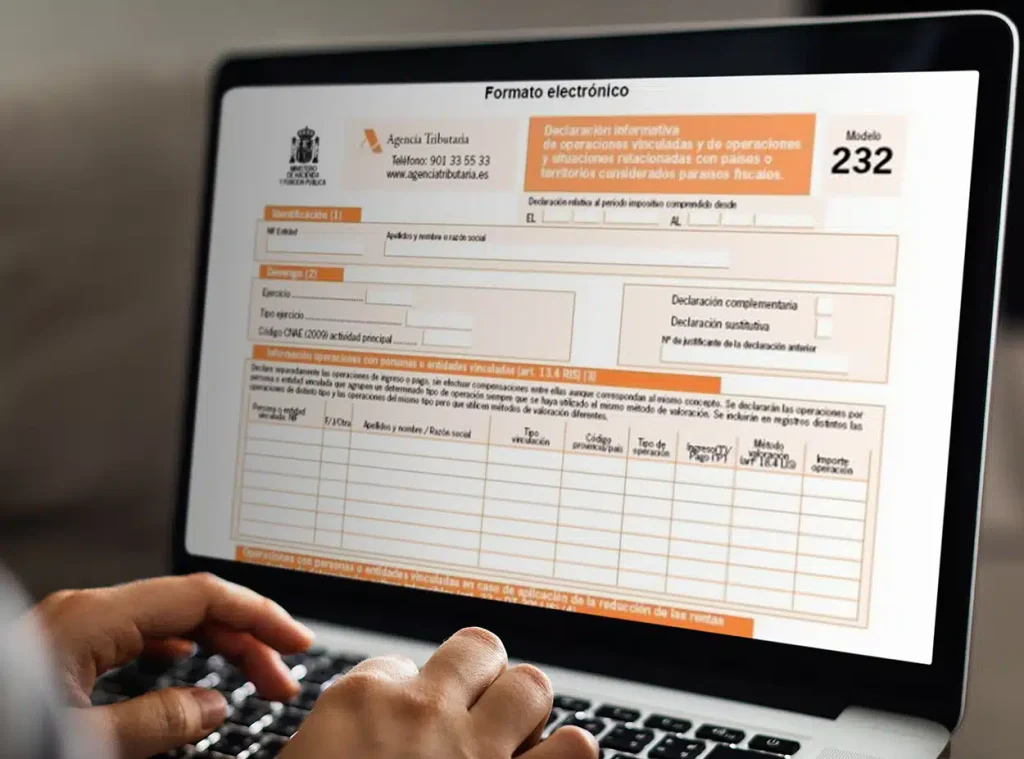
Form 232: Informative Return on Related-Party Transactions and Transactions or Situations Involving Countries or Territories Classified as Tax Havens
During the month of November, companies must comply with an important tax obligation: the filing of Form 232, an informative return concerning related-party transactions and transactions or situations involving countries or territories classified as tax havens.
What is Form 232?
Until the 2016 fiscal year, this information was included in Form 200 of the Corporate Income Tax return. However, for tax periods beginning on or after January 1, 2016, the Spanish Tax Agency requires this information to be filed separately through Form 232, with the aim of improving control and transparency in transactions between related entities.
Filing Deadline
Form 232 must be filed within the month following the ten months after the end of the tax period.
For example, if the fiscal year ends on December 31, the filing period will be from November 1 to November 30 of the following year.
Who Is Required to File?
The following must file Form 232: corporate income taxpayers, non-residents with a permanent establishment, and entities under the income attribution regime constituted abroad but with a presence in Spain, provided they carry out any of the following transactions:
- a) Transactions carried out with the same related person or entity when the total amount during the fiscal year exceeds €250,000, based on market value.
- b) Specific transactions (*) carried out with related persons or entities, when the total amount of each type of such transaction during the fiscal year exceeds €100,000.
- c) Transactions with related persons or entities of the same type using the same valuation method, when the total amount of such transactions during the fiscal year exceeds 50% of the entity’s net turnover.
- d) Transactions in which the taxpayer applies the reduction on income derived from certain intangible assets provided for in Article 23 of the Corporate Income Tax Law, because income is obtained from the transfer of such intangibles to related persons or entities.
- e) Transactions or holdings of securities in countries or territories classified as tax havens, regardless of the amount.
(*) The following are considered specific transactions:
(i) Those carried out by Personal Income Tax taxpayers engaged in an economic activity under the objective estimation method with entities in which they or their spouses, ascendants, or descendants hold, individually or jointly, 25% or more of the share capital or equity;
(ii) Transfers of businesses;
(iii) Transfers of shares or interests representing equity in entities not listed on regulated markets;
(iv) Transfers of real estate; and
(v) Transactions involving intangible assets.
Exemptions
The following transactions are exempt from reporting:
a) Transactions carried out between entities belonging to the same tax consolidation group.
b) Transactions carried out by Economic Interest Groupings (EIGs) and Temporary Business Associations (UTEs) (except when applying the regime established in Article 22 of the Corporate Income Tax Law).
c) Transactions carried out within the framework of public takeover bids or public offerings for sale.
Form 232 must be filed exclusively online, through the Electronic Headquarters of the Spanish Tax Agency (Agencia Tributaria).
The filing of Form 232 represents a key obligation for entities engaged in related-party transactions or those involving countries or territories classified as tax havens. Meeting this requirement accurately and within the established deadlines is essential to ensure transparency and proper compliance with tax obligations.
Sara Gámez Córdoba.



The new Notary Portal: legal and tax implications for the property market.
The Portal de la Vivienda del Notariado, launched in October 2025 by the Spanish General Council of Notaries, marks a milestone in market transparency and legal certainty within Spain’s real-estate sector. The public platform (penotariado.com/inmobiliario) provides free access to real transaction data derived directly from notarised deeds, updated monthly and searchable by region, municipality or postal code.
- Reference value vs. market value
Until now, the “cadastral reference value” established under Spain’s General Tax Law (LGT) served as the minimum taxable base for Transfer Tax (ITP-AJD), Inheritance and Gift Tax (ISD), and related levies. Because it relied on statistical models rather than notarised transactions, it often triggered disputes between taxpayers and the administration.
With the Notarial Portal, advisors finally have empirical market evidence for defending property valuations, contesting administrative assessments, and substantiating capital gains or fair market values in corporate and personal income tax matters.
- Tax planning and compliance
The dataset—covering more than 170 million notarised documents—provides insights into:
- Average €/m² by property type and region,
- Buyer nationality (Spanish/foreign),
- Year-on-year evolution, and
- Socio-demographic patterns over the last 12 years.
These indicators enable precise estate and corporate tax planning. Advisors may rely on notarised data to determine fair market value in related-party transactions (art. 18 Corporate Tax Act), justify depreciation adjustments, or support valuations in mergers and reorganisations.
- Legal certainty and evidentiary value
Because the data originate from public deeds signed before a notary, they enjoy presumptive legal validity under Spanish civil and procedural law. Thus, they may serve as compelling documentary evidence in litigation, administrative reviews, or property-tax disputes—something that private portals cannot offer.
- Broader transparency impact
From a public-law perspective, the platform strengthens compliance with Spain’s Transparency Law 19/2013 and the EU’s Open Data Directive 2019/1024, enhancing institutional trust and policy evaluation in the housing market. For international investors, this legal openness represents a significant improvement in Spain’s real-estate due diligence landscape.
In conclusion, the Notarial Portal is therefore a strategic legal-tax tool—transforming raw notarial data into defensible evidence, fairer taxation, and greater transparency in Spain’s property market.
Jesús Raya Zamora.


Import VAT Deferral in Spain: Application Period Open in November.
Companies that carry out import operations in Spain may benefit from the Import VAT Deferral Scheme (IVA diferido), which allows import VAT to be declared and deducted in the monthly VAT return rather than being paid at customs. This option can offer a significant cash-flow advantage, as it eliminates the need for an upfront VAT payment upon importation.
Key Features of the Import VAT Deferral Scheme
Under the deferral system, import VAT amounts are declared in the monthly VAT return (Form 303) and deducted at the same time. In practice, this means that no actual cash outflow occurs for the import VAT, making it a cash-neutral process for the importer.
The application period is open during the month of November, and the scheme will take effect from January for approved applicants. Companies must be registered in the monthly VAT return system (REDEME) to qualify for the regime.
Practical Considerations for Importers
Once the import VAT deferral system is applied, several operational points should be taken into account:
1. No changes required in customs declarations.
It is not necessary to indicate this option in import declarations. The customs clearance system automatically verifies, at the time of DUA admission, whether the importer has opted for VAT deferral.
2. Inclusion in the VAT return.
The VAT amounts assessed by the Tax Authorities must be included in the VAT return corresponding to the period in which the import clearance (“levante”) takes place.
3. Compliance and penalties.
Any import VAT amounts notified during a month but not included in the corresponding VAT return will automatically enter the enforcement process (periodo ejecutivo de cobro) on a FIFO basis.
Moreover, the omission or incorrect reporting of import VAT amounts liquidated by the Administration may constitute a tax infringement, potentially subject to penalties.
Advantages of the VAT Deferral System
- No advance payment of VAT at customs.
- Immediate offset in the monthly VAT return.
- Improved cash flow and liquidity management.
- Simplified import procedures.
How to Apply
Applications for the import VAT deferral regime must be submitted to the Spanish Tax Agency during November. The scheme will take effect from January of the following year.
If your company imports goods and wishes to take advantage of this scheme, or if you need advice on the procedure, please contact our firm. Our team will be happy to help you manage your application and answer any questions you may have.
Marina Guerrero Castronuño.